
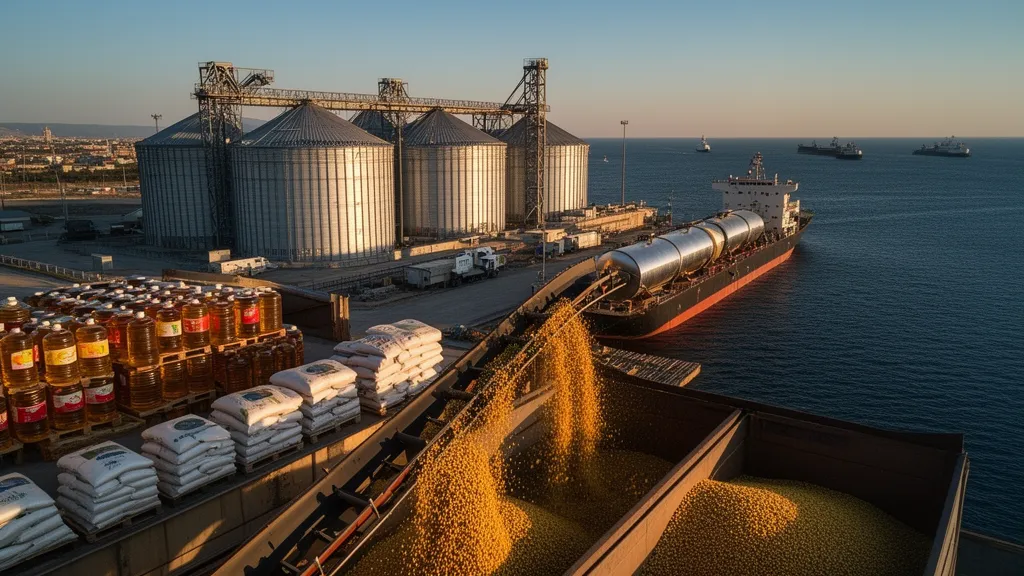
- Bullish: Sunflower oil FOB Black Sea and rapeseed oil FOB Netherlands advanced to weekly highs, while soybean meal prices strengthened globally on robust feed demand.
- Bearish: Soybean and palm oil benchmarks weakened across major origins, with multiple markets hitting weekly lows amid softer soft-oil sentiment.
Global Vegetable Oil and Oilseed Market Overview – February 6, 2026
Vegetable Oils
Vegetable oil markets showed a mixed performance on February 6, 2026. Sunflower oil FOB Black Sea advanced, while soybean and palm oil benchmarks weakened across key export hubs, highlighting diverging fundamentals within the soft oil complex.
| Commodity | Location / Contract | Price (USD/t) | Change (USD/t) | Comment |
|---|---|---|---|---|
| Sunflower oil | FOB Black Sea | 1,280.00 | +5.00 | Firm; reaching higher levels |
| Sunflower oil | CIF Mumbai, India | 1,412.90 | 0.00 | Steady at maximum value |
| Soybean oil | FOB Brazil | 1,174.20 | -20.40 | Weekly low |
| Soybean oil | US CBOT | 1,219.82 | -7.05 | Weaker |
| Soybean oil | FOB EU | 1,287.40 | -7.17 | Softening |
| Soybean oil | Dalian, China | 1,176.86 | -5.07 | Easing |
| Rapeseed oil | FOB Netherlands | 1,266.69 | +11.54 | Price maximum |
| Palm oil | FOB Malaysia | 1,067.14 | -12.44 | Weekly low |
| Palm kernel oil RBD | FOB Malaysia | 2,039.75 | -9.95 | Weekly low |
Sunflower oil FOB Black Sea rose to $1,280.00/t, confirming a modestly bullish tone in the Black Sea complex, while CIF Mumbai values held at a maximum. In contrast, soybean oil posted synchronized losses across Brazil, US, EU, and China, with Brazil FOB touching the weekly low. Rapeseed oil in the Netherlands bucked the downtrend with a solid gain to a fresh high. Palm oil and palm kernel oil FOB Malaysia both slid to weekly lows, highlighting pressure from ample supplies and competitive pricing.
Meals
Protein meals were generally firmer, led by soybean meal strength across all major benchmarks, signaling resilient demand from the feed sector.
| Commodity | Location / Contract | Price (USD/t) | Change (USD/t) | Comment |
|---|---|---|---|---|
| Soybean meal | FOB Brazil | 335.22 | +7.06 | Weekly high |
| Soybean meal | CIF EU | 389.05 | +11.94 | Price maximum |
| Soybean meal | US CBOT | 334.66 | +0.44 | Price maximum |
| Soybean meal | Dalian, China | 432.50 | +1.81 | Firm |
| Sunflower meal | CIF France | 259.96 | +0.92 | Marginal increase |
| Rapeseed meal | FOB EU | 293.04 | -1.32 | Slightly weaker |
Soybean meal rallied to or near weekly highs in Brazil, the EU and the US, with Dalian prices also edging higher. Sunflower meal in France posted only a small rise, while rapeseed meal FOB EU slipped modestly, indicating some rotation within the protein complex.
Oilseeds
Oilseed futures and physical benchmarks showed mixed direction, with soybeans diverging by origin and rapeseed maintaining a firmer tone.
| Commodity | Location / Contract | Price (USD/t) | Change (USD/t) | Comment |
|---|---|---|---|---|
| Soybeans | US CBOT | 409.78 | +1.10 | Maximum value |
| Soybeans | FOB Brazil | 416.81 | -0.70 | Slight decline |
| Soybeans | Dalian, China | 623.02 | -2.68 | Weaker |
| Rapeseed | MATIF France | 576.33 | +4.39 | Weekly high |
US CBOT soybeans edged up to a maximum, while Brazilian and Chinese soybean benchmarks softened, reflecting regional differences in supply-demand dynamics. Rapeseed on MATIF France climbed to a weekly high, underpinning firmness in the European oilseed complex.
Market Analysis and Outlook
The resilience in Black Sea sunflower oil, combined with firm rapeseed oil and strengthening global soybean meal prices, points to supportive crush margins for meal relative to oil. The simultaneous weakness in soybean and palm oil suggests cautious sentiment in the broader soft oil segment, with competitive palm pricing likely to cap rallies in other vegetable oils. Strong soybean meal demand may continue to underpin sunflower meal and support Black Sea sunflower product values.
Market Outlook: Neutral to slightly bullish for Black Sea sunflower products, with upside primarily driven by robust meal demand and relative tightness versus competing oils.
Source: OleoScope Market Data
Leave a Reply