
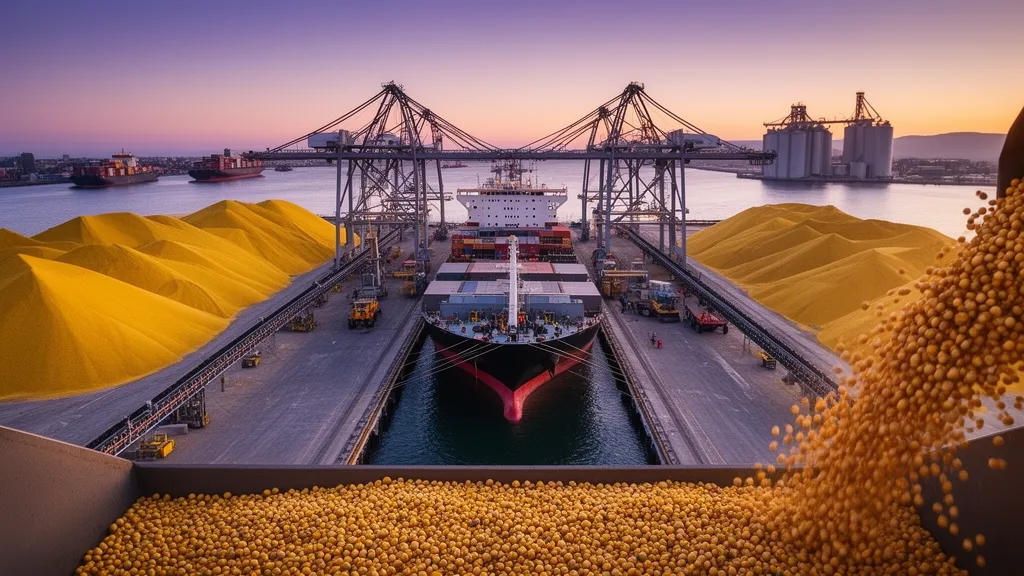
- Canadian canola exports to China collapsed 92% to 0.2 million tonnes in Aug–Nov 2025 due to prohibitive Chinese tariffs.
- Canadian soybeans gained share in China, with shipments up 48% YoY to a record 1 million tonnes, capturing 36% of total Canadian soy exports.
- Canola meal flows were successfully redirected, led by record US imports of 1.42 million tonnes and higher demand from the EU and Asian buyers.
- Market impact is neutral to slightly bullish for Black Sea oilseeds, but competition in EU and Asian meal and oil markets is set to intensify.
Market Update: Canadian Canola and Soy Trade Shifts
Canadian canola exports to China fell sharply in the first four months of the 2025/26 season (August–November 2025), dropping from 2.6 million tonnes a year earlier to just 0.2 million tonnes. The 92% collapse was driven by extremely high Chinese import tariffs on Canadian canola, which effectively shut Canadian product out of the Chinese market.
Trade normalization is expected from March 1, 2026, following a bilateral agreement between Canada and China to significantly reduce and partially eliminate the tariff restrictions on Canadian canola. This agreement should gradually restore Canada’s competitive position in China’s oilseed import mix.
Canadian Soybeans Fill Part of the Gap
Despite the canola restrictions, Chinese demand for Canadian soybeans remained robust. Canadian soybean shipments to China reached a record 1 million tonnes in August–November 2025, up 48% year-on-year. China accounted for 36% of total Canadian soybean exports in this period, compared with 26% in the same period a year earlier, underscoring China’s willingness to substitute soybean imports as canola access tightened.
Canola Meal Redistribution to US, EU, and Asia
Canadian processors responded to the loss of Chinese canola demand by discounting canola meal and aggressively targeting alternative markets. US imports of Canadian canola meal climbed to a record 1.42 million tonnes in August–November 2025, up from 1.29 million tonnes a year earlier. The European Union increased its purchases by 0.4 million tonnes, while the United Kingdom, Vietnam, Thailand, and South Korea also expanded imports. Overall, these gains more than offset the 0.7 million tonne decline in Chinese canola meal imports, highlighting the flexibility of global feed and oilseed demand.
Key Trade Flow Numbers
| Flow / Market | Aug–Nov 2024/25 | Aug–Nov 2025/26 | Change |
|---|---|---|---|
| Canadian canola exports to China | 2.6 million tonnes | 0.2 million tonnes | -2.4 million tonnes |
| Canadian soybean exports to China | 0.68 million tonnes* | 1.0 million tonnes | +0.32 million tonnes (+48%) |
| China share of Canadian soy exports | 26% | 36% | +10 percentage points |
| US imports of Canadian canola meal | 1.29 million tonnes | 1.42 million tonnes | +0.13 million tonnes |
| Change in Chinese canola meal imports | — | — | -0.7 million tonnes |
*Implied from 48% year-on-year growth to reach 1.0 million tonnes.
Implications for Black Sea Oilseeds and Logistics
The disruption in Canadian canola exports to China provided temporary support to competing origins, including Black Sea oilseeds, by removing a key supplier from the Chinese market. However, this advantage will diminish as the March 2026 tariff resolution restores Canadian access. In the meantime, Canada’s successful pivot to soybeans and canola meal underscores the elasticity of global oilseed demand and the ability of trade flows to reroute quickly when price incentives shift.
For Black Sea sunflower oil and meal exporters, the main risk lies in intensifying competition in the EU and Asian feed markets, where Canadian canola meal volumes are rising. Freight patterns may also see incremental changes as Canadian cargoes move relatively more toward Atlantic and European destinations and relatively less toward Pacific routes, contributing to a neutral to slightly bullish tone for Black Sea oilseeds while amplifying competition in downstream meal markets.
Source: Market Data
Leave a Reply