
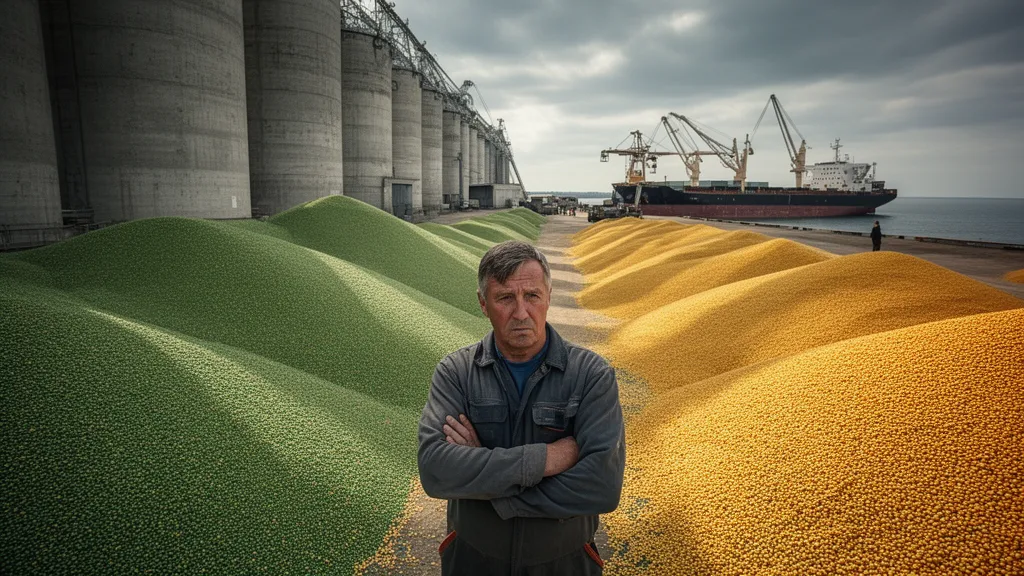
- Bearish Russia domestic: Severe oversupply in pulses and oilseeds has driven sharp price declines, with green lentils down 68% and soybeans down about 30% year-on-year.
- Mixed exports & freight: Lower prices could boost Russian export competitiveness and vessel demand, but sanctions, FX volatility, and logistics constraints limit the pace of export growth.
- Farm margins at risk: Farmers are pushing for faster, year-round export flows to sustain profitability in the face of collapsing domestic prices.
Russian Farmers Push for Accelerated Exports Amid Domestic Oversupply
Russian agricultural producers are grappling with intense price pressure caused by domestic oversupply after several years of diversifying away from wheat into pulses and oilseeds. According to Stanislav Sankeyev, Executive Director of the People’s Farmer Association, the core challenge has shifted from production capacity to securing consistent market access, especially export channels.
The 2025/26 season has seen overproduction in peas, soybeans, chickpeas, and lentils, with green lentils particularly hard hit. Prices for green lentils have dropped from about 88 rubles per kilogram in previous years to just 28 rubles, a collapse of roughly 68%, undermining profitability for producers who expanded into these specialty crops.
| Commodity | Price (Current) | Prior Price / YoY | Change |
|---|---|---|---|
| Green lentils (RUB/kg) | 28 | 88 (prior years) | -68% |
| Sunflower seeds | Early 2026 | Early 2025 | -7% to -8% YoY |
| Rapeseed | Early 2026 | Early 2025 | -15% YoY |
| Soybeans | Early 2026 | Early 2025 | ≈ -30% YoY |
Dmitry Rylko, Director General of the Institute for Agricultural Market Studies (IKAR), highlighted that oilseed prices weakened notably in early 2026, with sunflower seed prices down 7–8% year-on-year, rapeseed off by 15%, and soybeans registering the steepest decline at about 30%. Russia has reached soybean self-sufficiency and export price parity in European Russia more quickly than expected, already evident in the 2025/26 season. Despite the price slump, IKAR does not anticipate a reduction in soybean acreage in 2026, instead projecting a stabilization in planted area.
Farmers are therefore calling for faster, year-round export flows to support margins, but the pace of outbound shipments is constrained by sanctions from unfriendly countries, volatility in the ruble–dollar exchange rate, and broader international commodity price dynamics and logistics limitations.
Market Implications and Freight Outlook
The oversupply across Russian specialty crops and oilseeds points to further downside risk for domestic prices in the near term, potentially enhancing Russia’s competitiveness in export markets as origin prices fall. However, structural constraints in trade finance, sanctions regimes, and supply-chain capacity mean that export acceleration may be gradual rather than immediate.
For Black Sea freight markets, increased urgency to move surplus volumes could support demand for vessel capacity if export programs expand. Nonetheless, geopolitical restrictions and routing challenges are likely to cap the upside for freight rates. Traders and shipowners should watch whether low Russian prices are sufficient to stimulate incremental demand and absorb the surplus, particularly in price-sensitive import markets.
Source: Market Data
Leave a Reply