
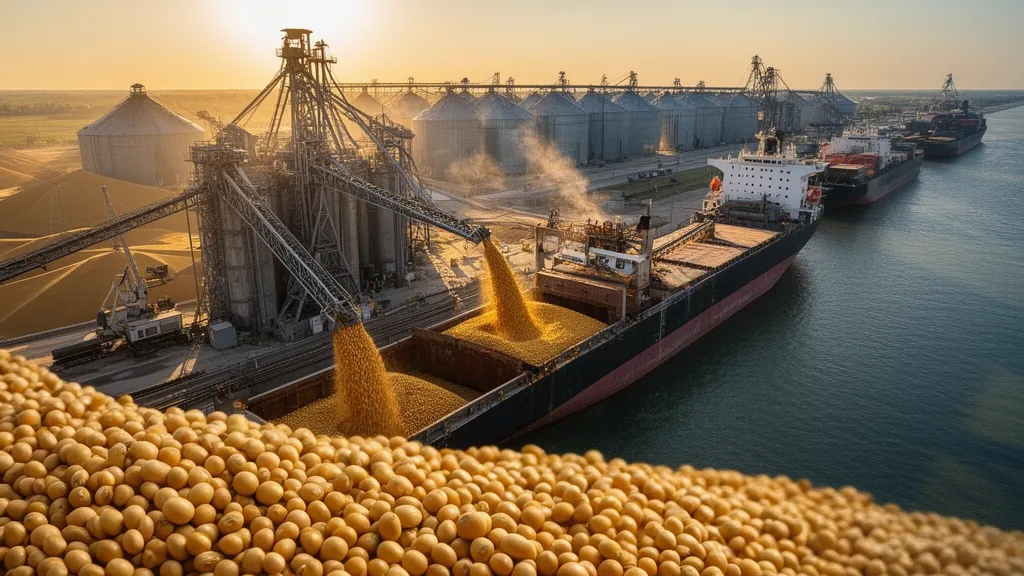
- Bullish: Strong global demand pushed U.S. soybean complex exports up 13% year-on-year to 68.7 million metric tons, with record soybean meal and a 304% surge in soybean oil shipments.
- Bearish: Competitive U.S. pricing and expanding presence in key importers like Turkey and Egypt add neutral-to-slightly bearish pressure on Black Sea soybean exporters.
U.S. Soybean Export Performance 2024-25
U.S. soybean complex exports (whole beans, soybean meal, and soybean oil) reached 68.7 million metric tons in the 2024-25 marketing year, up 13% from the prior year and 2.9% above the five-year average. The total export value was $29.6 billion, underscoring robust global demand.
| Product | 2024-25 Volume (million tonnes) | Year-on-Year Change |
|---|---|---|
| Total soybean complex | 68.7 | +13% |
| Whole soybeans | 51.2 | +11% |
| Soybean meal | 16.3 | +14% |
| Soybean oil | 1.1 | +304% |
Whole soybean exports accounted for the bulk of shipments at 51.2 million tonnes, an 11% year-on-year increase. Soybean meal exports hit a record 16.3 million metric tons, 14% higher than the previous year. Soybean oil showed the most dramatic growth, surging 304% to 1.1 million tonnes.
Key Destination Markets
China, Mexico, the EU-27, Egypt, and the Philippines were the top markets for the U.S. soybean complex in 2024-25. India led soybean oil purchases, followed by Mexico, Colombia, Venezuela, and the Dominican Republic. Soybean meal exports flowed primarily to the Philippines, Mexico, Colombia, and Canada, reflecting strong demand from animal feed sectors.
| Category | Top Buyers |
|---|---|
| Overall soybean complex | China, Mexico, EU-27, Egypt, Philippines |
| Soybean oil | India, Mexico, Colombia, Venezuela, Dominican Republic |
| Soybean meal | Philippines, Mexico, Colombia, Canada |
Five-Year Growth in Key Markets
Over the past five years, Turkey has emerged as the fastest-growing market for U.S. soybean complex exports, with volumes up 342%. Vietnam and Venezuela also saw strong growth, alongside Colombia and Bangladesh, highlighting the broadening geographic base of U.S. demand.
| Market | Five-Year Export Growth |
|---|---|
| Turkey | +342% |
| Vietnam | +89% |
| Venezuela | +68% |
| Colombia | +48% |
| Bangladesh | +40% |
USSEC CEO Jim Sutter linked this performance to expanding animal protein demand, improved market access, and competitive U.S. soybean pricing, which has enhanced America’s position in price-sensitive destinations.
Implications for Black Sea Soybean Exporters
The strong 13% rise in U.S. soybean complex exports exerts neutral to slightly bearish pressure on Black Sea exporters, particularly in shared markets such as Turkey and Egypt. Competitive U.S. pricing and increased penetration in Turkey—where U.S. shipments grew 342% over five years—could force Ukrainian and Russian suppliers to reassess price strategies to defend market share.
However, diversified global demand and fragmented regional supply chains suggest that multiple origins can still be absorbed. Black Sea traders should closely track U.S. price movements and flows into key partners like Turkey and Egypt to identify arbitrage opportunities and timing advantages rather than expecting a collapse in regional demand.
Source: Market Data
Leave a Reply