
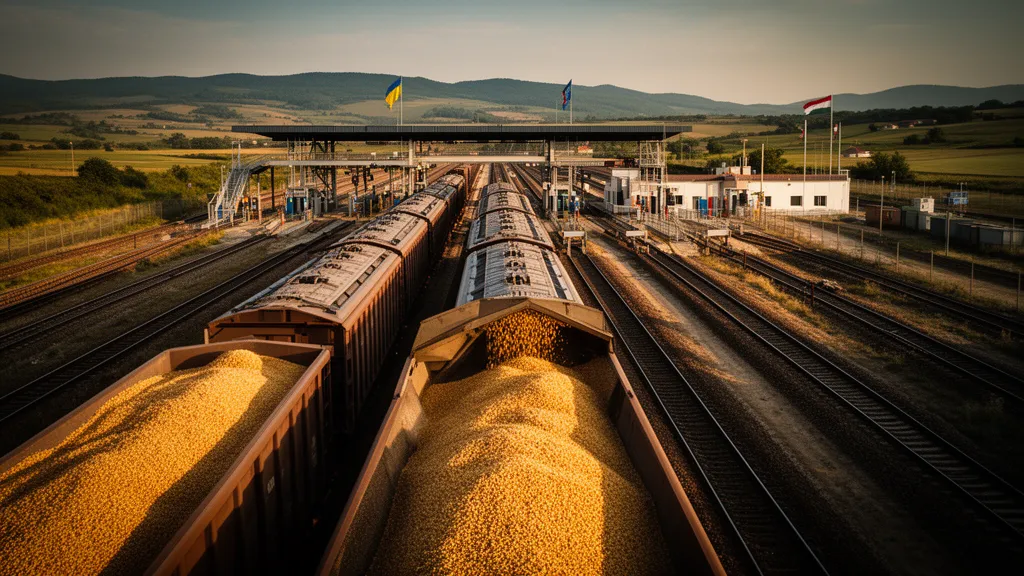
- Hungary Emerges as Key Corridor: Ukrainian grain rail exports have pivoted toward Hungary, with flows rising to 58.4 railcars/day in January, making it the dominant route.
- Alternative Routes Weaken: Rail grain transfers via Slovakia, Poland, and Romania have all declined, led by Slovakia’s 8.1 railcars/day drop to 22.9 railcars/day.
- Logistics Risk Concentration: The growing reliance on Hungary concentrates transit risk in a single corridor, a neutral to slightly bearish signal for exporters dependent on alternative routes.
- Potential Transit Premiums: Improved efficiency at the Hungarian border may support premium pricing for guaranteed capacity as traders compete for limited slots.
Ukraine Shifts Grain Rail Exports to Hungary
Ukrainian grain exports by rail have undergone a notable route redistribution in January, according to Valeriy Tkachev, Deputy Director of the Department of Transportation Technology and Commercial Work at JSC Ukrzaliznytsia. As of January 20, Hungary has become the primary rail destination for Ukrainian grain shipments.
Daily transfers at the Hungarian border increased by 6.8 railcars compared with December 2025, reaching 58.4 railcars per day. Hungary is the only border crossing showing growth over the reporting period, underscoring its rising importance in Ukraine’s grain logistics network.
Border Crossing Flows: January Rail Grain Transfers
| Border Crossing | Daily Grain Transfers (railcars/day) | Change vs Dec 2025 (railcars/day) |
|---|---|---|
| Hungary | 58.4 | +6.8 |
| Slovakia | 22.9 | -8.1 |
| Poland | 7.8 | -4.1 |
| Romania | 5.1 | -2.8 |
Market Update
The latest rail data highlight a clear concentration of Ukrainian grain flows through Hungary, which now accounts for roughly 62% of monitored border rail traffic by volume. In contrast, Slovakia, Poland, and Romania all registered declining throughput in January.
Slovakia recorded the sharpest pullback, with average daily transfers falling by 8.1 railcars to 22.9 railcars per day. Poland’s rail shipments declined by 4.1 railcars per day to 7.8 railcars per day, while Romania saw a 2.8 railcars-per-day decrease to 5.1 railcars per day.
Logistics and Market Implications
The growing dominance of the Hungarian route suggests a strategic logistics pivot, likely driven by improved border infrastructure, better processing capacity, or more favorable transit and regulatory arrangements. For traders and exporters, the shift is neutral to slightly bearish for those relying on alternative gateways, which now face lower utilization and potentially higher unit costs.
Greater dependence on a single corridor raises concentration risk. Market participants should closely monitor capacity constraints and any regulatory or operational changes at the Hungarian border. Securing guaranteed transit slots via Hungary may command a premium, particularly during peak export windows, while the weaker flows through Poland and Romania could signal either temporary bottlenecks or a more durable realignment of regional grain trade routes.
Source: Market Data
Leave a Reply