
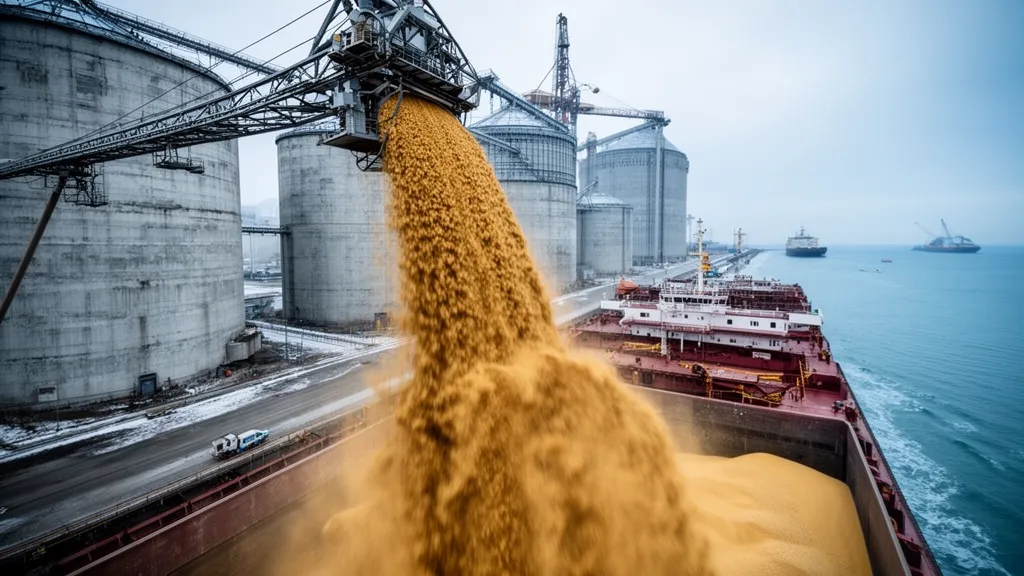
- Russian wheat, barley, and corn export duties remain at zero through February 3, extending cost support for exporters.
- Indicative wheat prices eased to $226.3/ton, signaling softer demand despite policy support.
- Russian grain exports fell 17.6% y/y in July–December 2025, with the buyer base shrinking from 69 to 49 countries.
- Guinea’s interest in Russian wheat offers marginal new demand but does not offset broader export weakness.
- Overall backdrop is neutral to bearish as global competition erodes Russia’s market share.
Russian Wheat Export Duties Remain at Zero
The Russian Ministry of Agriculture has confirmed that export duties on wheat will remain at zero for the third consecutive week starting January 28, with the current regime in place through February 3. Barley and corn export duties also remain at zero, extending a long-running period of duty-free grain exports from Russia.
The continued absence of export duties supports the international competitiveness of Russian grain, lowering the effective cost basis for buyers and potentially enabling Russian exporters to offer more aggressive pricing into key import markets.
Updated Indicative Prices and Damper Mechanism
The latest duty calculations are based on revised indicative prices set on the Moscow Exchange. Wheat prices declined slightly to $226.3 per ton from $227.7, barley fell to $201.2 per ton from $203.8, while corn rose to $203.3 per ton from $199.6.
Under Russia’s grain damper mechanism, in place since June 2, 2021, export duties are determined as 70% of the difference between fixed base prices and the indicative prices. The base price is 18,000 rubles per ton for wheat and 17,875 rubles per ton for both barley and corn. Current market levels keep the calculated duty at zero across all three commodities.
| Commodity | Indicative Price (Latest) | Previous Period | Direction |
|---|---|---|---|
| Wheat | $226.3/ton | $227.7/ton | ▼ |
| Barley | $201.2/ton | $203.8/ton | ▼ |
| Corn | $203.3/ton | $199.6/ton | ▲ |
Export Flows and Customer Base
Despite duty-free exports, Russian agricultural shipments are weakening. Overall agricultural exports fell 8% year-on-year in the first eleven months of 2025 to $35.9 billion, according to Federal Customs Service data. The Russian Grain Union reported that grain exports dropped 17.6% to 33.9 million tons during July–December 2025.
The customer base for Russian wheat has narrowed sharply. Only 49 countries purchased Russian wheat in July–December 2025, down from 69 countries during the same period in 2024, indicating a meaningful erosion of market reach and diversification.
| Metric | Latest Period | Previous Period | Change |
|---|---|---|---|
| Grain exports (July–Dec 2025) | 33.9 million tons | 41.1 million tons (approx.) | -17.6% |
| Wheat-buying countries | 49 | 69 | -20 countries |
| Agricultural exports (Jan–Nov 2025) | $35.9 billion | $39.0 billion (approx.) | -8% |
Emerging Demand from Guinea
On the demand side, Guinea has expressed interest in purchasing Russian wheat, alongside imports of construction materials. Ambassador Nyankoy Aba has indicated the country’s readiness to expand trade in these sectors, potentially adding a modest new outlet for Russian grain.
While positive at the margin, Guinea’s prospective demand is unlikely to offset the broader contraction in Russian wheat’s global customer base, especially given intensified competition from other major exporters.
Market Implications and Trader Takeaways
The current setup is best characterized as neutral to bearish. Zero export duties improve Russian wheat’s price competitiveness, yet the decline in indicative wheat prices, shrinking export volumes, and a reduced roster of buyers underline demand-side pressure and loss of market share.
Traders should watch upcoming export statistics to gauge whether the continuation of zero duties can stabilize or revive shipments, or if global competition and geopolitical constraints will continue to limit Russian grain flows into key import markets.
Source: Market Data
Leave a Reply