
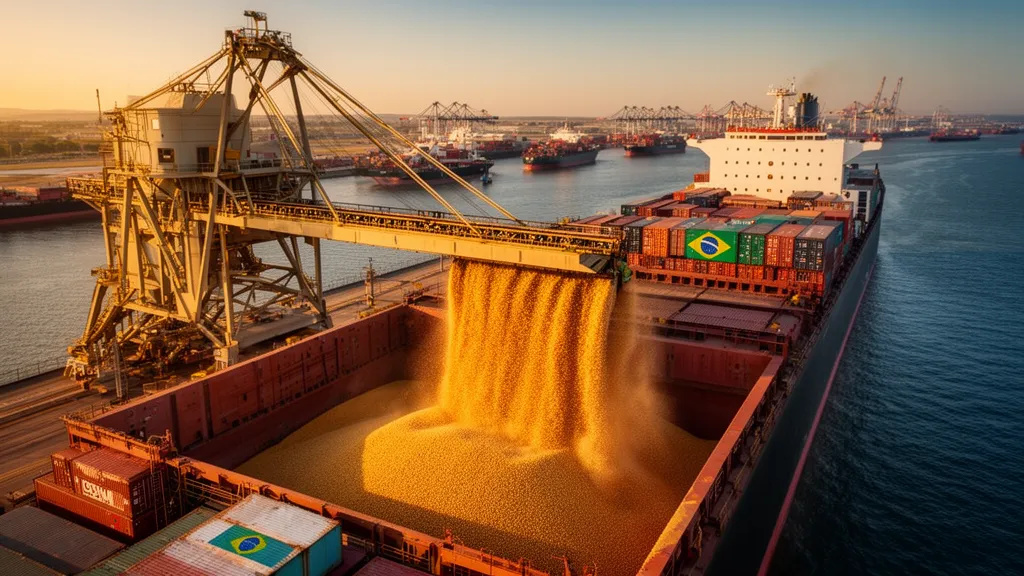
- Neutral/Bearish Black Sea soybeans: South American competition intensifies as Brazil expands soybean meal exports 10.7% y/y and captures larger shares of China’s soybean complex demand.
- Supportive crush margins: Elevated Brazilian FOB soybean meal prices at $321.78/t and strong Chinese buying may underpin global crush demand, providing some offset to origin-premium pressure.
- Chinese demand reshuffling: Record annual soybean imports (112 Mt) alongside a sharp shift from U.S. to Argentine supply highlights China’s procurement flexibility and potential for further origin switching.
- Russian oil footprint grows: Russia captured 93.46% of China’s December soybean oil imports, underscoring its rising role in value-added soybean products despite low absolute volumes.
China Soybean and Soybean Oil Trade Snapshot
China imported 8.04 million tons of soybeans in December 2025, up 1.29% year-on-year but 0.78% lower than November. Brazil remained the dominant supplier with 5.65 million tons (70.3%), followed by Argentina at 1.65 million tons (20.53%). For the full year 2025, soybean imports reached 111.82 million tons, down 6.46% versus 2024, with U.S. shipments falling 24% to 16.8 million tons (15.03% share) while Argentine volumes surged 92.4% to 7.89 million tons.
Soybean oil imports into China contracted sharply in December 2025 to 6,200 tons, a drop of 87.91% month-on-month and 23.61% year-on-year. Russia supplied 5,800 tons, capturing 93.46% of the monthly market. Over the full year, China imported 345,500 tons of soybean oil, up 22.49% from 2024. Argentina led annual deliveries with 148,800 tons (43.06%), followed by Russia at 98,600 tons (28.53%) and Brazil at 93,300 tons (26.99%).
Brazilian Soybean Meal Export Dynamics
The Brazilian National Association of Grains Exporters (ANEC) projects January 2026 soybean meal exports at 1.82 million tons, compared with 1.644 million tons in January 2025, a 10.7% year-on-year increase. Strong export programs coincide with firm FOB Brazil soybean meal prices, supported by active Chinese purchasing and rising contract positions on Chinese exchanges.
| Item | Period | Volume / Price | Change |
|---|---|---|---|
| China soybean imports | Dec 2025 | 8.04 Mt | +1.29% y/y; -0.78% m/m |
| China soybean imports | Full-year 2025 | 111.82 Mt | -6.46% vs 2024 |
| U.S. soybean shipments to China | Full-year 2025 | 16.8 Mt (15.03% share) | -24% y/y |
| Argentina soybean shipments to China | Full-year 2025 | 7.89 Mt | +92.4% y/y |
| China soybean oil imports | Dec 2025 | 6,200 t | -87.91% m/m; -23.61% y/y |
| Russia share of China soybean oil imports | Dec 2025 | 5,800 t (93.46%) | Share sharply higher on low total volume |
| China soybean oil imports | Full-year 2025 | 345,500 t | +22.49% vs 2024 |
| Brazil soybean meal exports | Jan 2026 (proj.) | 1.82 Mt | +10.7% vs Jan 2025 |
| FOB Brazil soybean meal | 21 Jan 2026 | $321.78/t | +$0.90/t d/d; weekly high |
Market Impact and Price Sentiment
Fundamentally, the setup is neutral to slightly bearish for Black Sea soybeans. Russia’s dominance in December soybean oil flows to China highlights its competitive edge in processed products but comes against a backdrop of very low absolute volumes. In contrast, Brazil’s record production and expanding soybean meal exports tighten global meal availability, supporting higher FOB values and reinforcing Brazil’s central role in China’s protein feed supply chain.
China’s pivot away from U.S. soybeans toward increased Argentine supply underlines its willingness to reoptimize origin mix based on price and logistics. If South American logistics remain efficient through Q1 2026, Black Sea origin premiums could face pressure, even as robust Chinese buying and firmer meal prices help sustain crush margins globally.
Source: Market Data
Leave a Reply