
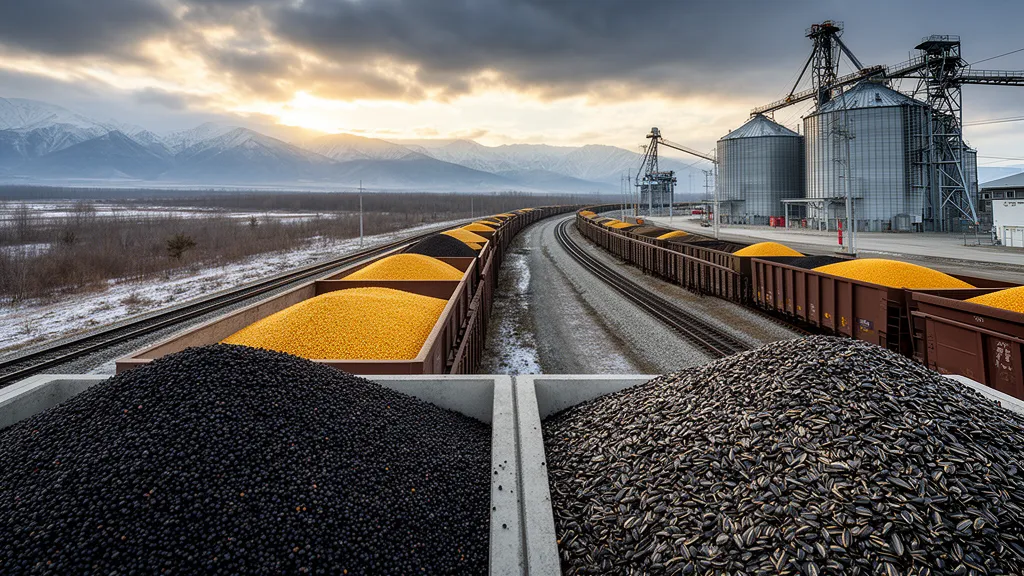
- Russia extends Trans-Baikal sunflower seed and rapeseed export quotas to August 31, 2026, preserving preferential access to Asian buyers.
- Rapeseed export capacity from the region nearly triples to 28,251 tonnes, leveraging record national rapeseed output.
- Strong duty differential (6.5% vs. 30%) guarantees full quota utilization and supports competitive pricing versus other Black Sea origins.
- Market impact assessed as neutral to slightly bearish for Black Sea sunflower seed premiums; broadly neutral for the wider oilseed complex.
Russia Extends Trans-Baikal Oilseed Export Quotas
The Russian government has extended export quotas for sunflower seed and rapeseed from the Trans-Baikal Territory (Zabaykalsky Krai) until August 31, 2026, seven months beyond the previous expiry of January 31, 2026. The move preserves a controlled export channel to Asian markets while maintaining oversight of domestic oilseed availability and prices.
Quota Volumes and Structure
Existing quota volumes are maintained at 5,033 tonnes for sunflower seed and 9,451 tonnes for rapeseed. In addition, authorities have introduced a new rapeseed quota of 18,800 tonnes for the Trans-Baikal region, lifting the total rapeseed export allowance from this corridor to 28,251 tonnes through August 31, 2026.
| Item | Volume (tonnes) | Notes |
|---|---|---|
| Sunflower seed export quota (Trans-Baikal) | 5,033 | Unchanged; valid to Aug 31, 2026 |
| Rapeseed export quota (existing) | 9,451 | Unchanged base volume |
| Rapeseed export quota (additional) | 18,800 | New allocation for Trans-Baikal |
| Total rapeseed export quota (Trans-Baikal) | 28,251 | Existing + additional quota |
Tariff Regime and Export Incentives
The extended regime preserves a dual-tariff structure that strongly incentivizes exports within quota limits. Shipments under the quota are charged a 6.5% duty, with a minimum of €11.4 per tonne. Any volumes exceeding the quota face a much steeper 30% duty, with a minimum of €165 per tonne, applicable through August 31, 2026. This framework was put in place after Russia lifted its outright rapeseed export ban on September 1, 2024.
| Regime | Duty Rate | Minimum Duty (€/tonne) | Validity |
|---|---|---|---|
| Within quota | 6.5% | €11.4 | To Aug 31, 2026 |
| Above quota | 30% | €165 | To Aug 31, 2026 |
Production Context
According to preliminary Rosstat data, Russia harvested a record 5.6 million tonnes of rapeseed in 2025, up 19% from 4.7 million tonnes in 2024. The enlarged Trans-Baikal rapeseed quota aligns with this surge in production, enabling additional export flows without fully liberalizing the trade regime.
| Year | Rapeseed Harvest (million tonnes) | Year-on-Year Change |
|---|---|---|
| 2024 | 4.7 | — |
| 2025 (preliminary) | 5.6 | +19% |
Market Impact and Price Signals
The Trans-Baikal region’s proximity to Asian markets, particularly China, makes it a strategic outlet for incremental rapeseed exports. While the sunflower seed quota remains modest, the expanded rapeseed quota could modestly enhance competition in rapeseed and rapeseed oil sourcing versus other Black Sea origins as crushers and traders seek competitively priced supply.
The sharp duty gap between in-quota and above-quota exports virtually guarantees full utilization of the allocated volumes, anchoring aggressive price offers for quota-linked shipments. Nonetheless, the overall effect on the broader oilseed complex is assessed as neutral, with only a slightly bearish bias for Black Sea sunflower seed premiums due to limited sunflower volumes in the measure.
Source: Market Data
Leave a Reply