
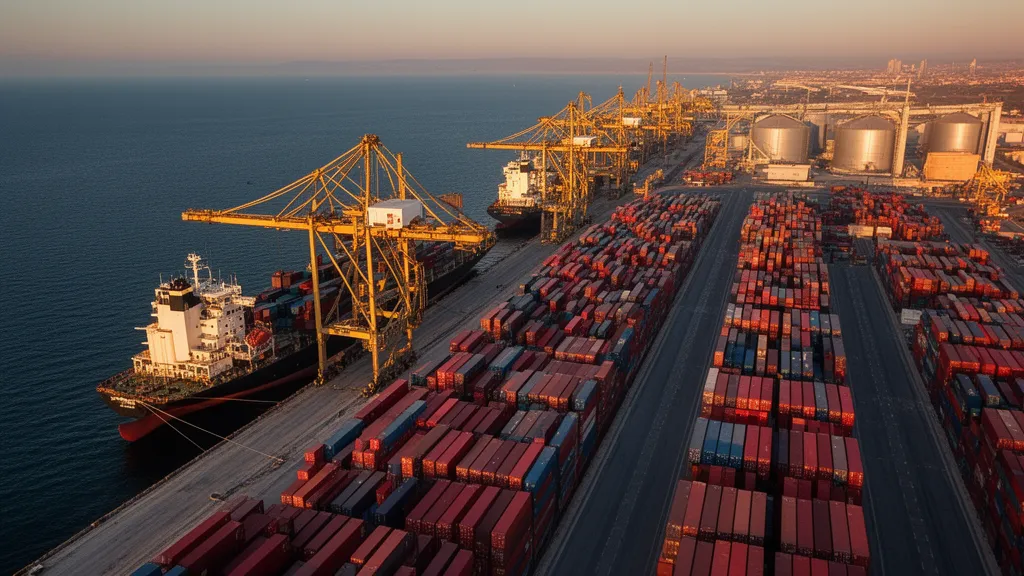
- Chornomorsk port appeal: Over 40 international bidders signal strong interest in Ukraine’s largest wartime port PPP, with pre-qualification due by March 4, 2025.
- Capacity boost: Concession plan targets 250,000 TEU containers and 3 million tons of bulk cargo within three years, supporting over 1,000 jobs and around $1 billion in budget revenues.
- Russian dairy resilience: 2025 dairy exports exceeded $500 million to nearly 100 countries, slightly below last year’s volume but with stronger value despite ruble headwinds.
- Mixed product dynamics: Whey and permeate shipments surged 33.7%, while cheese exports declined and fermented milk products were flat, reflecting shifting product and market mix.
- Market outlook: Neutral to slightly bullish for Ukrainian freight infrastructure; neutral for broader Black Sea logistics due to limited short-term capacity additions.
Market Update: Chornomorsk Port Concession
Ukraine’s Ministry of Development reports that the concession tender for the first terminal and container terminal at Chornomorsk port has attracted interest from more than 40 international port operators and investors. The project is positioned as Ukraine’s largest port industry investment and the first public-private partnership implemented during wartime, with the state retaining ownership of the asset.
The concession is expected to generate roughly $1 billion in additional budget revenues and preserve more than 1,000 jobs. The tender is being conducted under a three-stage competitive dialogue procedure, with the European Bank for Reconstruction and Development (EBRD) and the International Finance Corporation (IFC) acting as international advisors.
Operational plans for the first year of activity envisage handling about 250,000 TEU containers and 3 million tons of bulk cargo. The prequalification deadline for interested operators is set for March 4, 2025, marking the next key milestone in advancing the project.
Russian Dairy Export Performance
Russia’s dairy export sector recorded preliminary 2025 exports exceeding $500 million across nearly 100 destination countries, according to Agroexport head Ilya Ilyushin. Despite currency headwinds, this value outpaced 2024 levels, supported by product mix and geographic diversification to markets including China, Algeria, Egypt, and Turkey.
In volume terms, total dairy exports reached 191,900 tons in 2025 versus 195,600 tons in 2024, reflecting marginal contraction. Cheese and cottage cheese accounted for 32% of total export volume, fermented milk products 24%, and ice cream 15%, underlining the importance of higher-value processed products in the export basket.
| Indicator | 2024 | 2025 (Prelim.) | Change |
|---|---|---|---|
| Total dairy export value | Below $500 million | Over $500 million | Higher value YoY |
| Total dairy export volume | 195,600 tons | 191,900 tons | -3,700 tons |
| Whey & permeate volume | ~28,300 tons (est.) | 37,800 tons | +33.7% |
| Cheese exports volume | 26,500 tons | 22,800 tons | -3,700 tons |
| Fermented milk products volume | 74,100 tons | 74,100 tons | Unchanged |
| Dairy share of agri exports | ~1.2% | ~1.2% | Stable |
Currency dynamics remained a key constraint: the ruble’s strength in the 78–80 per US dollar range weighed on price competitiveness, particularly for powdered milk exports to non-CIS destinations. The National Union of Milk Producers notes that this limited volume growth even as exporters expanded their reach to new markets.
Analysis and Market Outlook
The strong response to the Chornomorsk concession tender underscores investor confidence in Ukrainian port infrastructure despite ongoing conflict. If implemented on schedule, the planned container and bulk capacity expansion at Chornomorsk should improve freight availability and potentially ease handling costs for Black Sea grain and oilseed flows from 2026–2027 onward.
On the Russian side, dairy remains a small but growing component of agricultural exports at around 1.2% of the total. The sector’s value growth and broader geographic footprint are contributing to more diversified Black Sea–linked freight routes, although currency volatility will continue to shape Russia’s overall agri-export competitiveness, including grains and oilseeds.
Overall, the outlook is neutral to slightly bullish for Ukrainian freight infrastructure as Chornomorsk advances, while the near-term impact on aggregate Black Sea logistics capacity remains limited, keeping the broader regional outlook neutral.
Source: Market Data
Leave a Reply