
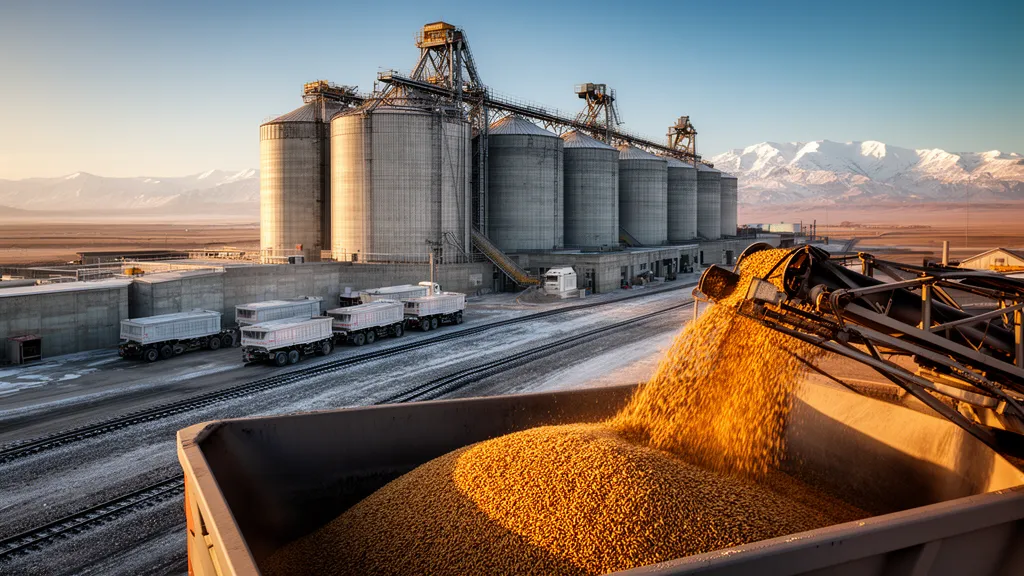
- Kazakhstan wheat export prices: Rose by USD 1–3/t across grades, with Grade 5 reaching USD 208–212/t DAP Saryagash.
- Domestic price divergence: Lower-grade wheat gained 1,000 tenge/t while premium Grade 3 wheat lost 2,000 tenge/t.
- Exports accelerating: Extended transport subsidies to 2026 and stronger demand from Central Asia and Transcaucasus are boosting shipments.
- Farmer selling pressure low: Producers are withholding stocks amid frost-related logistics issues and expectations of further price increases.
- Market sentiment: Overall bullish, with narrowing spreads between quality tiers and persistent upward price pressure.
Market Update
Kazakhstan’s wheat market showed mixed but generally supportive dynamics over the past week, with a clear divergence between premium and lower-grade wheat. Export quotations moved higher across all grades, while domestic prices reflected stronger demand for feed and lower-quality wheat alongside softening premiums for top-quality milling wheat.
Domestic Wheat Prices (Ex-Warehouse)
| Grade / Specification | Price Range (tenge/t) | Weekly Change (tenge/t) |
|---|---|---|
| Grade 3, gluten 23–24 | 89,000–93,000 | +1,000 |
| Grade 4 | 81,000–85,000 | +1,000 (approx., lower grades up) |
| Grade 5 | 78,000–81,000 | +1,000 (approx., lower grades up) |
| Grade 3, gluten 28–29 (premium) | 118,000–122,000 | -2,000 |
| Grade 3, gluten 30+ (premium) | 132,000–136,000 | -2,000 |
Domestic prices for Grade 3 wheat with gluten 23–24 increased by 1,000 tenge/t to 89,000–93,000 tenge. Grade 4 wheat held in the 81,000–85,000 tenge band and Grade 5 wheat at 78,000–81,000 tenge, with lower grades generally gaining about 1,000 tenge/t. In contrast, premium Grade 3 wheat with gluten 28–29 fell to 118,000–122,000 tenge, and 30+ gluten eased to 132,000–136,000 tenge, both down 2,000 tenge/t.
Export Wheat Prices (DAP Saryagash)
| Grade / Specification | Price Range (USD/t, DAP Saryagash) | Weekly Change (USD/t) |
|---|---|---|
| Grade 3, gluten 23–24 | 229–234 | +1 |
| Grade 4 | 218–223 | +1 (upward momentum) |
| Grade 5 | 208–212 | +3 |
Export prices advanced on all major wheat grades under DAP Saryagash terms. Grade 3 wheat with 23–24 gluten rose by USD 1/t to USD 229–234/t, Grade 4 traded at USD 218–223/t, and Grade 5 recorded the strongest gain, rising USD 3/t to USD 208–212/t.
Regional Logistics and Export Dynamics
According to Evgeniy Karabanov, head of the analytical committee of the Grain Union of Kazakhstan, export shipments have accelerated year-on-year to Central Asia, Azerbaijan, Georgia, the port of Poti, Russian Baltic ports, and the Baltic states. The key driver is the extension of transportation cost subsidies for wheat exports, now confirmed through 2026, which improves the competitiveness of Kazakhstan wheat on regional markets.
Despite robust export flows, partial restrictions remain on shipments to China via the Dostyk and Altynkol border posts, limiting access to that important destination and concentrating volumes toward Central Asian and Transcaucasus routes.
Farmer Behavior and Weather Impact
Severe frosts last week disrupted grain deliveries from farm warehouses to elevators, constraining physical availability in the spot market. Many producers have adopted a wait-and-see approach, withholding sales in anticipation of additional price gains, especially given rising export quotations and ongoing state support mechanisms.
Market Analysis and Outlook
Market Sentiment: Bullish. The narrowing spread between premium and lower-grade wheat points to firm demand for lower-quality wheat, supported by subsidized export channels. The Food Corporation’s direct procurement announcement in late December continues to underpin prices domestically and in key Central Asian outlets.
Farmer reluctance to sell, combined with weather-related logistics disruptions and accelerating export demand, suggests that upward price pressure is likely to persist in the near term. Traders and millers should closely monitor the capacity and utilization of subsidized export routes, as well as any changes in Chinese border restrictions, as these factors will materially influence available supply and basis levels.
Source: Market Data
Leave a Reply