
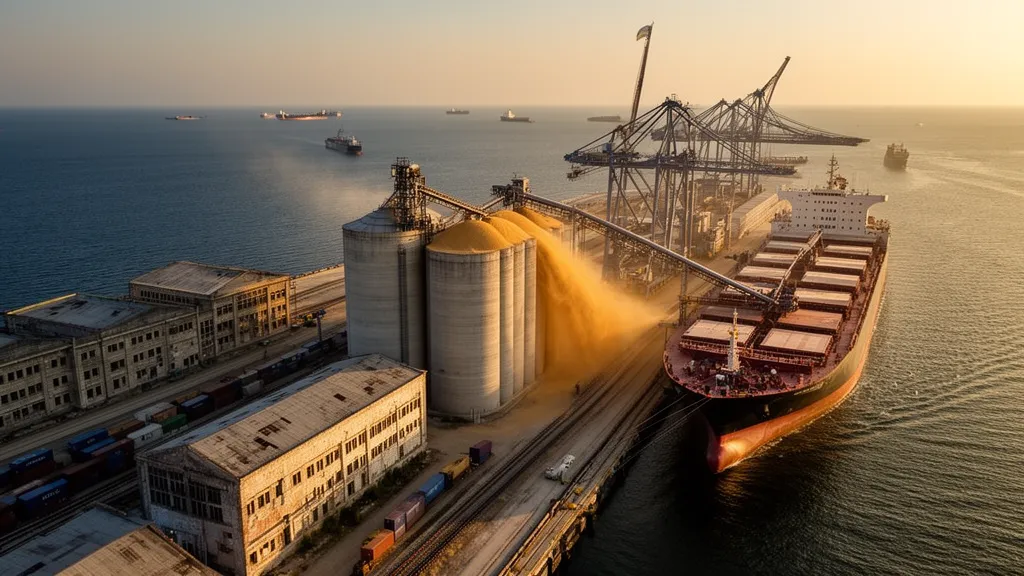
- Logistics consolidation: Romania’s full acquisition of Giurgiulesti Port and planned €24M+ investment aim to integrate the terminal into Danube–Black Sea freight corridors, improving export efficiency and regional capacity.
- Cost support for exporters: Zero Russian export duties on wheat, barley, and corn through January 27 keep Black Sea grain exports price-competitive despite slightly softer indicative prices.
- Capacity expansion: Russia’s projected 35.1 million tons of added port capacity by 2026, including 6.4 million tons on the Azov–Black Sea route, supports long-term freight growth but may pressure freight rates if capacity outpaces demand.
Regional Logistics Update
The Romanian government has finalized the acquisition of Danube Logistics, operator of the Giurgiulesti International Free Port in Moldova, from the EBRD. Final price approval is expected on February 11. Romania has committed over €24 million for modernization and expansion, targeting integration of Giurgiulesti into its domestic logistics network and reinforcing freight capacity along the Danube–Black Sea transport corridors. The move is strategically aimed at easing bottlenecks and improving grain and general cargo flows from Moldova and Romania.
Russian Grain Export Duties
For the period January 21–27, 2025, Russian export duties on wheat, barley, and corn remain at zero rubles per ton. The Ministry of Agriculture’s latest calculations show small declines in indicative prices, while base prices are unchanged. This is the second consecutive week of zero export duties, sustaining competitive export pricing from Russian Black Sea ports.
| Commodity | Indicative Price (USD/tonne) |
Previous (USD/tonne) |
Change (USD/tonne) |
Export Duty |
|---|---|---|---|---|
| Wheat & meslin | $227.7 | $229.2 | -1.5 | 0 RUB/ton |
| Barley | $203.8 | $219.6 | -15.8 | 0 RUB/ton |
| Corn | $199.6 | $200.6 | -1.0 | 0 RUB/ton |
| Commodity | Base Price (RUB/ton) |
|---|---|
| Wheat | 18,000 |
| Barley | 17,875 |
| Corn | 17,875 |
Russian Port Capacity Expansion
Russian Transport Minister Andrei Nikitin outlined plans to add 35.1 million tons of port capacity by 2026. The Northwest region will gain 15.5 million tons through new terminals such as EuroChem’s fertilizer facility in Ust-Luga, Novotrans Aktiv’s Ust-Luga terminal, and the Vysotsky grain terminal. Eastern ports will add 13.2 million tons via container and coal terminals in Vladivostok. On the Azov–Black Sea route, reconstruction at Tuapse port and Togliattiazot’s ammonia and fertilizer transshipment complex will contribute 6.4 million tons of new capacity.
| Region / Route | Planned Additional Capacity (million tons) |
Key Assets |
|---|---|---|
| Northwest Russia | 15.5 | EuroChem fertilizer terminal (Ust-Luga), Novotrans Aktiv terminal (Ust-Luga), Vysotsky grain terminal |
| Eastern Ports (Vladivostok) | 13.2 | New container and coal terminals |
| Azov–Black Sea Route | 6.4 | Tuapse port reconstruction; Togliattiazot ammonia & fertilizer transshipment complex |
| Total Planned Capacity | 35.1 | Nationwide expansion across key export corridors |
Market Impact
The combined effect of Romania’s Giurgiulesti acquisition, ongoing zero Russian grain export duties, and Russia’s 2026 capacity build-out is neutral to slightly bullish for Black Sea freight volumes. Improved infrastructure and supportive export policies should sustain flows, but growing port capacity—especially on the Azov–Black Sea route—may intensify competition among regional export corridors and exert downward pressure on freight rates if demand growth lags capacity additions.
Source: Market Data
Leave a Reply