
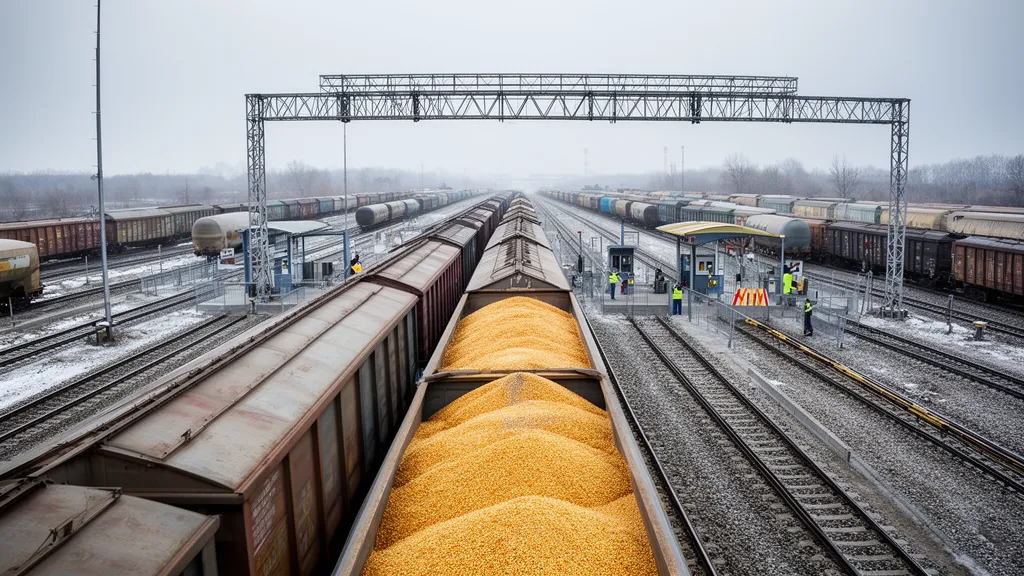
- Rail exports trimmed: Ukraine’s average daily grain rail transfers to the EU fell 7.6% in early January to 171 tons per day.
- Border bottlenecks: Sharpest cuts were recorded at the Polish (down 6.3 cars/day) and Romanian (down 2.6 cars/day) crossings, tightening export capacity.
- Hungary offsets partially: The Hungarian border was the only route with higher volumes, up 6.1 tons/day to 57.7 tons/day, offering limited relief.
- Neutral to bearish bias: Persistent congestion could pressure freight premiums and disrupt Jan–Feb delivery schedules for Ukrainian grain.
Ukraine Rail Grain Export Flows: Early January Shift
Ukraine’s state railway operator JSC Ukrzaliznytsia reported a meaningful slowdown in grain and meal rail freight flows at EU border crossings in early January. As of January 13, the average daily transfer rate dropped to 171 tons per day, a decline of 14 tons (7.6%) versus December 2026 levels. The pullback underscores growing logistical friction along key western export corridors.
Border Crossing Performance
| Border Crossing | Metric | Current Level | Change vs. Dec 2026 |
|---|---|---|---|
| All EU borders (average) | Grain & meal transfers | 171 tons/day | -14 tons/day (-7.6%) |
| Slovakia | Grain railcars | 28.2 cars/day | -2.8 cars/day |
| Poland | Grain railcars | 5.6 cars/day | -6.3 cars/day |
| Romania | Grain railcars | 5.3 cars/day | -2.6 cars/day |
| Hungary | Grain transfers | 57.7 tons/day | +6.1 tons/day |
By route, the Polish border posted the steepest percentage contraction, with grain rail transfers falling to just 5.6 cars per day, down 6.3 cars from December averages. Romania’s crossing also weakened, sliding to 5.3 grain cars per day after a 2.6-car reduction. Slovakia saw a more moderate decline to 28.2 grain cars per day, 2.8 fewer than the previous month.
Hungary was the only notable outlier on the upside. Transfers there increased by 6.1 tons per day at the start of January, lifting total flows to 57.7 tons per day and partially offsetting cuts elsewhere along the EU border.
Market Impact and Freight Outlook
Bias: Neutral to Bearish for Ukrainian grain freight. The 7.6% reduction in rail transfer volumes points to mounting capacity constraints at several EU border crossings. While the stronger Hungarian corridor helps, it is unlikely to fully counterbalance the combined slowdowns in Poland, Romania, and Slovakia.
For traders and logistics managers, the key risk is that sustained congestion into late January and February could widen freight premiums and disrupt delivery schedules for nearby shipment windows. Monitoring daily railcar allocations, dwell times at border terminals, and any regulatory or infrastructure changes along the Polish and Romanian routes will be critical to assessing whether these bottlenecks deepen or ease.
Source: Market Data
Leave a Reply