
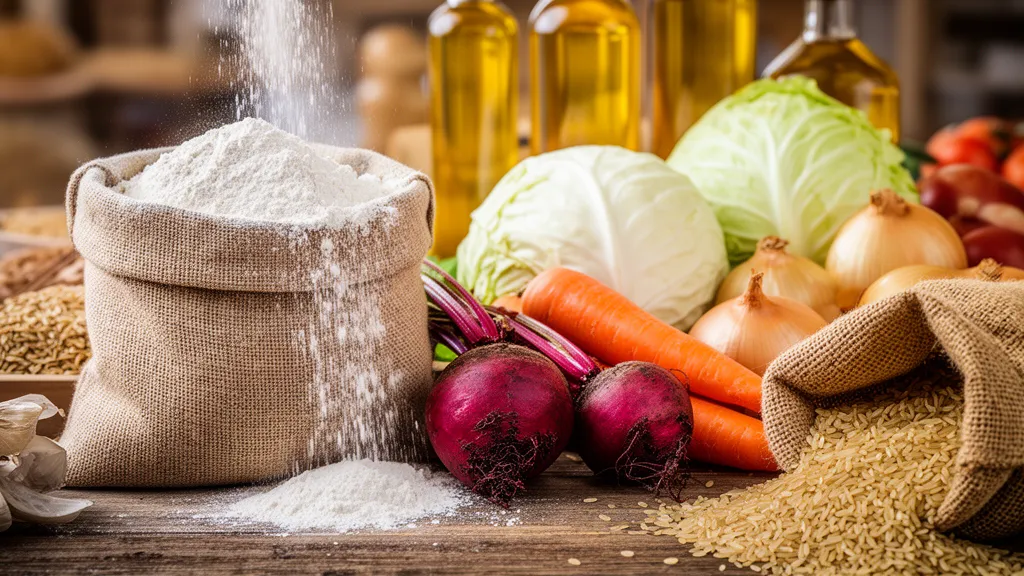
- Bearish for prices: Socially significant “first price” food products in Russia fell 9.3% year-on-year in December 2025, with borscht vegetables down 28% and broad declines across grains and sugar.
- Margin pressure: Retailers sold seven key categories below cost, including sunflower oil at a -1.8% markup and deep losses on carrots and white cabbage, reflecting policy-driven efforts to curb food inflation.
- Neutral to bearish for Black Sea grain: A 14% annual drop in wheat flour prices and cheaper feed grains signal robust domestic supply, reducing Russia’s near-term import needs and influencing export pricing dynamics.
Russian Retail Food Price Moves – December 2025
Major Russian retail chains reported broad-based food price declines in December 2025, led by agricultural commodities. According to ACORT, socially significant “first price” products were 9.3% cheaper year-on-year, with vegetables used for borscht down around 28% overall. Of 25 monitored product categories, 16 showed annual declines, underscoring a disinflationary trend in basic food staples.
Grains and staple crops saw some of the sharpest moves. Rice prices fell 41% year-on-year, white cabbage 38%, potatoes 31%, onions 25%, and carrots 19.7%. Wheat flour declined 14% versus December 2024 and 1.2% versus November 2025, pointing to ample milling wheat availability from the 2024/25 harvest. Granulated sugar dropped 15% year-on-year, though month-on-month it slipped only 0.3%, suggesting a slower pace of further easing.
| Product | Period | Price Change |
|---|---|---|
| Socially significant “first price” basket | Year-on-year (Dec 2025) | -9.3% |
| Borscht vegetables (basket) | Year-on-year (Dec 2025) | -28% (approx.) |
| Rice | Year-on-year (Dec 2025) | -41% |
| White cabbage | Year-on-year (Dec 2025) | -38% |
| Potatoes | Year-on-year (Dec 2025) | -31% |
| Onions | Year-on-year (Dec 2025) | -25% |
| Carrots | Year-on-year (Dec 2025) | -19.7% |
| Wheat flour | Year-on-year (Dec 2025) | -14% |
| Wheat flour | Month-on-month (vs Nov 2025) | -1.2% |
| Granulated sugar | Year-on-year (Dec 2025) | -15% |
| Granulated sugar | Month-on-month (vs Nov 2025) | -0.3% |
| Onions | Month-on-month (Dec 2025) | +8.5% |
| Carrots | Month-on-month (Dec 2025) | +5.8% |
| Potatoes | Month-on-month (Dec 2025) | +5.6% |
| Beets | Month-on-month (Dec 2025) | +3.3% |
| White cabbage | Month-on-month (Dec 2025) | +2.2% |
| Buckwheat | Month-on-month (Dec 2025) | -5.2% |
| Rice | Month-on-month (Dec 2025) | -3.2% |
| Butter | Month-on-month (Dec 2025) | -1.6% |
| Average retail markup (socially significant products) | Dec 2025 vs Dec 2024 | 3% (down 1.8 p.p.) |
Retail Margins and Subsidized Pricing
Despite lower shelf prices, many retailers are operating with compressed or negative margins on core staples. Seven monitored categories were sold below purchase cost in December. Sunflower oil showed a -1.8% markup, indicating that retailers fully absorbed costs and more. Carrots (-10.4%) and white cabbage (-7.6%) registered the steepest negative margins, with companies subsidizing an average of 2.9 rubles per kilogram on carrots and 2.2 rubles per kilogram on cabbage.
The average retail markup on socially significant products stands at just 3%, 1.8 percentage points lower than in December 2024. This pattern is consistent with a policy-influenced pricing environment, where retail chains are pressured to restrain food inflation even at the expense of profitability, particularly in politically sensitive product groups such as sunflower oil and basic vegetables.
| Product | Retail Markup | Subsidy / Loss Detail |
|---|---|---|
| Sunflower oil | -1.8% | Sold below cost to contain consumer prices |
| Carrots | -10.4% | ~2.9 RUB/kg subsidized by retailers |
| White cabbage | -7.6% | ~2.2 RUB/kg subsidized by retailers |
| Socially significant basket (average) | +3.0% | Down 1.8 p.p. vs Dec 2024 |
Seasonal Trends and Borscht Vegetable Dynamics
On a month-on-month basis, seasonal pressures began to show in December. Prices for vegetables used in traditional borscht recipes moved higher: onions rose 8.5%, carrots 5.8%, potatoes 5.6%, beets 3.3%, and white cabbage 2.2%. These increases follow substantial year-on-year declines and likely reflect seasonal storage and logistics costs rather than a structural tightening of supply.
In contrast, several storable staples continued to edge lower into year-end. Buckwheat fell 5.2% month-on-month, rice 3.2%, and butter 1.6%. Taken together, the data suggest that while seasonal vegetable volatility is returning, the broader staple food complex remains well supplied and disinflationary at the retail level.
Implications for Black Sea Grain Markets
For Black Sea grain markets, the signal is broadly neutral to bearish. The 14% annual decline in wheat flour prices and softness in feed grains such as rice and millet point to comfortable domestic grain stocks in Russia after the 2024/25 harvest. This reduces the urgency for additional import tenders and underscores Russia’s continued role as a competitively priced exporter rather than a demand driver.
However, the deliberate compression of retail margins, particularly the negative pricing on sunflower oil, indicates strong government pressure to cap food inflation. If this pressure cascades upstream to processors and farmers via administered prices or informal guidance, it could suppress farmgate returns and potentially delay future investment. Over time, such interventions might distort export pricing, limit flexibility on the international market, and affect the competitiveness of Russian-origin products, especially if domestic prices are held artificially low relative to global benchmarks.
Seasonal vegetable price gains bear monitoring into Q1 2026. Persistent increases beyond normal winter patterns could flag tightening storage capacity, logistics bottlenecks, or regional supply issues. For now, though, the dominant signal for grains and oilseeds remains one of strong domestic availability and constrained retail margins rather than outright scarcity.
Source: Market Data
Leave a Reply