
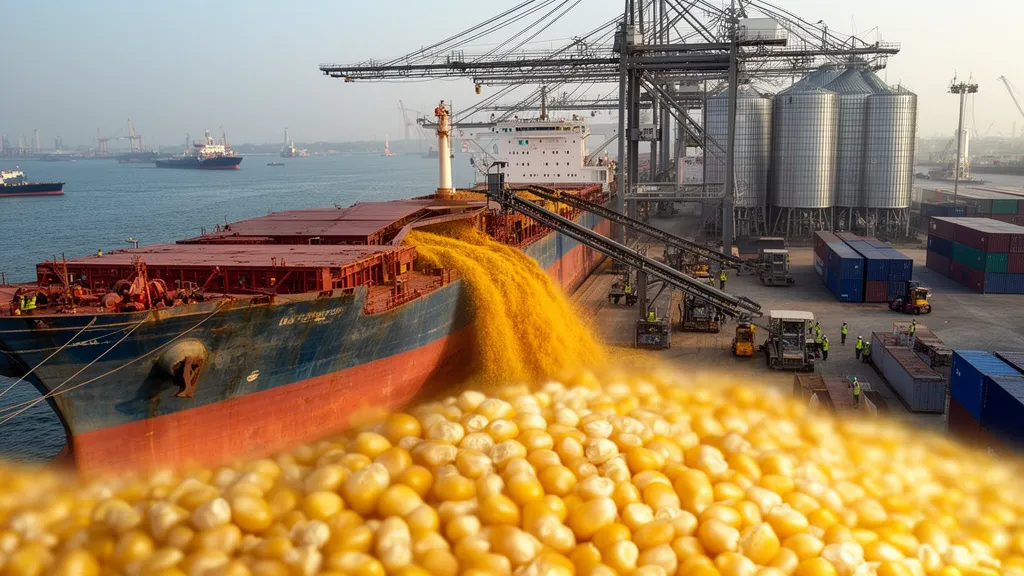
- First U.S. corn cargo since 2018: A 57,855-tonne shipment arrived in Chittagong on January 7, signaling renewed U.S. price competitiveness in Bangladesh.
- Import growth: Bangladesh’s 2025–26 corn imports are forecast at 1.5 million tonnes, up 6% year-over-year, driven largely by expanding poultry feed demand.
- Brazil’s dominance challenged: Brazil currently holds a 93% share of Bangladesh’s corn imports, but U.S. re-entry could gradually erode South American and Black Sea market share.
- Feed sector expansion: Around 150 registered mills produce 7.5 million tonnes of feed annually, 70% of which is poultry feed, underpinning rising corn consumption to a projected 6.9 million tonnes in 2025–26.
- Neutral to slightly bearish for Black Sea exporters: Stronger U.S. participation in Asian demand centers like Bangladesh may pressure margins and volumes for Black Sea origins.
U.S. Corn Returns to Bangladesh Market
Bangladesh received its first shipment of U.S. corn in eight years on January 7, when a vessel carrying 57,855 tonnes docked at the Port of Chittagong. The corn was sourced from North Dakota, South Dakota, and Minnesota, and shipped via the Port of Vancouver, Washington, marking a notable re-entry of U.S. origin into a market long dominated by South American suppliers.
The cargo was purchased by a consortium of major Bangladeshi feed producers, including Nahar Agro Group, Paragon Group, and Nourish Poultry and Hatchery Ltd. United Grain Corp. supplied the shipment and has indicated an interest in building a long-term supply relationship with these buyers, suggesting further U.S. volumes could follow if price competitiveness is maintained.
Bangladesh Corn Demand and Feed Sector Dynamics
According to USDA Foreign Agricultural Service data, U.S. corn has become price competitive for the 2025–26 marketing year, aligning with Bangladesh’s growing feed demand. Total corn imports are forecast at 1.5 million tonnes in 2025–26, a 6% year-over-year increase, as the country’s poultry sector continues to expand and require more energy-rich feed ingredients.
Bangladesh’s feed industry comprises roughly 150 registered milling companies producing about 7.5 million tonnes of commercial feed annually. Poultry feed represents about 70% of this output, and corn is the primary component in these formulations. Total corn consumption for feed is projected to rise 2.9% to 6.9 million tonnes in 2025–26, underscoring the structural growth in demand that is attracting global suppliers.
Shift in Supplier Structure
Brazil currently dominates Bangladesh’s corn supply with a 93% market share, followed by Argentina at 4%, while Pakistan and India play only minor roles. The arrival of U.S. cargo after an eight-year absence signals that competitive U.S. pricing, alongside logistical and quality considerations, is beginning to challenge Brazil’s near-monopoly position.
| Supplier | Estimated Market Share in Bangladesh Corn Imports |
|---|---|
| Brazil | 93% |
| Argentina | 4% |
| Pakistan | Minor supplier |
| India | Minor supplier |
| United States | Re-entering market (first cargo since 2018) |
Implications for Black Sea Corn Exporters
The U.S. re-entry into Bangladesh is neutral to slightly bearish for Black Sea corn exporters. While Brazil still commands the bulk of volumes, U.S. price competitiveness in the 2025–26 marketing year introduces another strong origin into an already crowded export landscape. As Bangladesh’s import needs grow by an estimated 6%, some additional demand will be available, but increased competition among U.S., South American, and Black Sea suppliers could compress margins.
If U.S. exporters can sustain favorable pricing and reliable logistics to South and Southeast Asia, this move may foreshadow a broader push into Asian markets traditionally served by Black Sea origins. Traders and risk managers should monitor U.S. shipment flows, basis levels, and freight spreads to gauge whether this Bangladesh cargo is a one-off opportunity or the beginning of a more structural shift in regional corn trade.
Source: Market Data
Leave a Reply