
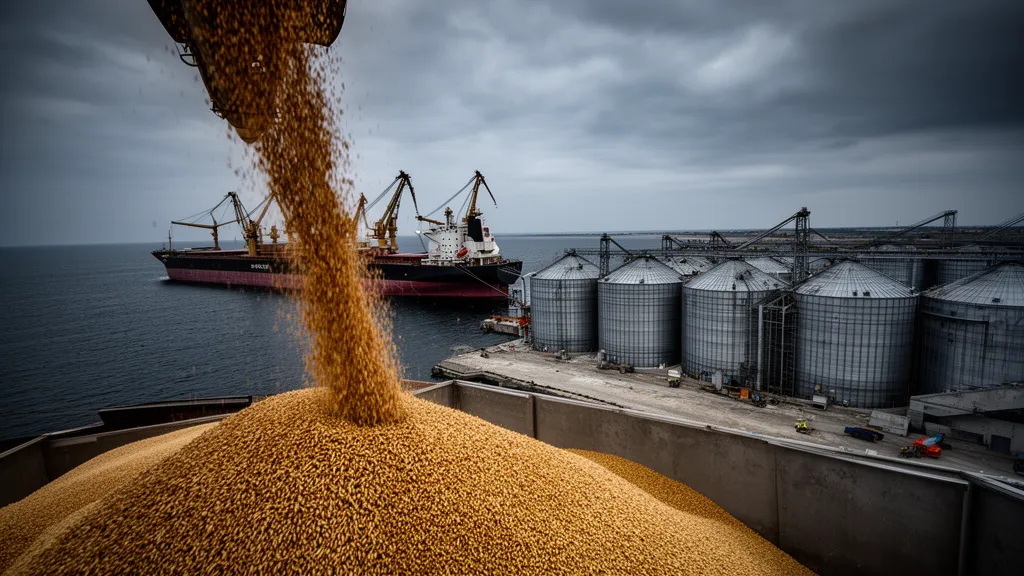
- Bearish: Russian grain exports declined 17.6% year-on-year to 33.9 million tons in July–December 2025, with wheat shipments down 14% and the number of export destinations shrinking from 69 to 49.
- Bearish: Active exporting companies dropped to 97 from 235, and key ports such as Novorossiysk and Rostov-on-Don recorded lower throughput, signaling weaker freight demand.
- Neutral-to-bullish: Russian wheat has shifted from a $6/ton premium to a $2/ton discount versus European wheat, which could support a rebound in second-half shipments if discounts widen.
- Risk: Iran’s growing role as a buyer may face headwinds from new US import restrictions on countries trading with Iran, potentially complicating Russian export flows.
Russian Grain Export Performance
Russia exported 33.9 million tons of major grain crops in the first half of the 2025/26 agricultural year (July–December 2025), down 17.6% from 41.2 million tons a year earlier, according to Russian Grain Union data. Wheat accounted for 82.5% of total shipments at 27.9 million tons, a 14% decline from 32.5 million tons, underscoring broad-based weakness across the export complex.
Barley exports dropped 27.9% to 3.2 million tons, while corn shipments fell 11.7% to 1.8 million tons. The number of active exporting companies contracted sharply to 97 from 235, highlighting consolidation in the export market and reduced participation in Black Sea grain trade.
Top Importers and Trade Flows
Egypt remained the largest buyer of Russian wheat with 5.35 million tons imported, a 21% decline year-on-year. Turkey ranked second with 4.234 million tons, nearly doubling volumes from a low 2024 base. Bangladesh took third position at 1.833 million tons (down 33%), followed by Israel with 1.773 million tons (up 10.8%) and Iran with 1.627 million tons (up 2.7 times), underscoring a notable shift in regional demand patterns.
At the same time, Algeria and Morocco significantly reduced purchases, likely redirecting demand toward European wheat, while the overall number of destination countries fell from 69 to 49. This contraction signals erosion of Russia’s market share in more price-sensitive import markets.
Port and Logistics Activity
Port performance mirrored the export slowdown. Novorossiysk handled 12.847 million tons of grain, down 5.7% year-on-year, while roadstead transshipment volumes dropped 29% to 6.304 million tons. Throughput at Rostov-on-Don declined 22.4% to 4.190 million tons. Softer volumes, combined with fewer active exporters, point to subdued freight demand in the near term for Black Sea grain routes.
Price Dynamics and Competitiveness
| Item | Period / Basis | Value | Change vs Start of Season |
|---|---|---|---|
| Russian Wheat FOB | Novorossiysk (Dec 2025) | $226/ton | -$10 (-4.2%) |
| European Wheat FOB | Benchmark | $228/ton | N/A |
| Russian vs European Wheat | FOB Spread | -$2/ton (discount) | From +$6/ton premium |
| Russian Producer Price | Domestic, USD terms | $171/ton | -$25 (-13%) from $196/ton |
Russian wheat (FOB Novorossiysk) ended the period at $226/ton, down $10 or 4.2% from early-season levels. This placed Russian origin at a $2/ton discount to European wheat at $228/ton, reversing a $6/ton premium that had previously constrained demand. In dollar terms, producer prices fell 13% to $171/ton from $196/ton, improving nominal competitiveness but pressuring farm margins.
The shift from premium to discount pricing occurs against a backdrop of expanding global supply. EU wheat exports are projected at 32.5 million tons versus 27.9 million tons in the prior season, while Australian exports are expected to reach 27 million tons versus 21.3 million tons. Additional competition from Argentina has eroded Russia’s traditional pricing edge in Black Sea markets.
Export Outlook and Market Sentiment
Russian Grain Union analyst Elena Tyurina estimates export potential for the full 2025/26 agricultural year at 46–47 million tons, but heightened competition may cap realized exports nearer 44–45 million tons. The reduced number of destination countries and active exporters suggests that even with a price discount, regaining lost market share may be gradual.
Iran has emerged as a significant buyer of Russian wheat, barley, and corn, but newly announced US import restrictions on countries trading with Iran pose a potential headwind. Any tightening of sanctions or associated financial constraints could disrupt established trade routes and limit Russia’s ability to capitalize on this demand.
Overall sentiment for Russian grain freight volumes remains bearish in the near term, given lower first-half exports, weaker port activity, and intense competition from Europe, Australia, and Argentina. However, if Russian wheat maintains or widens its discount to European origin, a neutral-to-bullish shift in second-half shipment volumes is possible as price-sensitive buyers recalibrate sourcing strategies.
Source: Market Data
Leave a Reply