
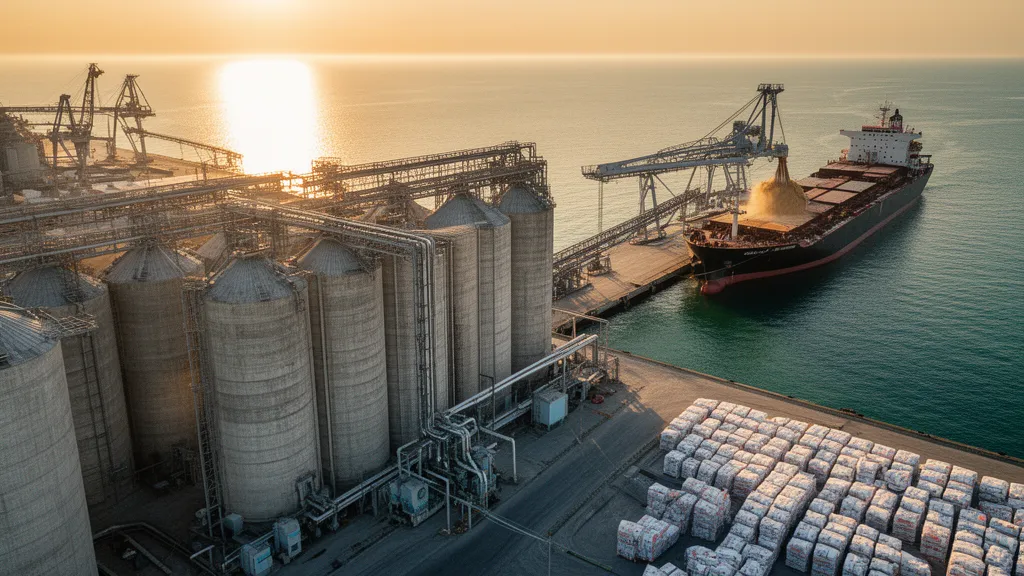
- Capacity Growth: Grain handling at Makhachkala Commercial Seaport rose 17% year-on-year in 2025 to 300,000 tons.
- Near-Term Expansion: First stage of a new grain terminal in 2026 is expected to boost capacity by 30% to about 390,000 tons annually.
- Long-Term Positioning: Full terminal completion by end-2028 aims to make Makhachkala the largest grain facility on the Caspian Sea.
- Modal Diversification: Cement transshipment has more than doubled, reaching 70,000–90,000 tons per month in 2025.
- Market Impact: Expansion is neutral to moderately bullish for Caspian freight routes, easing regional bottlenecks but with limited effect on Black Sea exports.
Makhachkala Port Grain and Cement Volume Trends
| Metric | Period | Volume | Change |
|---|---|---|---|
| Grain throughput | 2024 | ≈256,410 tons* | — |
| Grain throughput | 2025 | 300,000 tons | +17% YoY |
| Projected grain capacity | Post-Phase 1 (2026) | ≈390,000 tons/year | +30% vs. 2025 |
| Cement transshipment (monthly max) | May 2024 | 40,000 tons | — |
| Cement transshipment (monthly range) | 2025 | 70,000–90,000 tons | >2.2× vs. 2024 peak |
*2024 grain throughput back-calculated from 2025 +17% YoY increase.
Market Update
Makhachkala Commercial Seaport is moving ahead with a major grain infrastructure upgrade, with the first phase of a new grain terminal scheduled for launch in 2026. This initial stage is expected to increase the port’s grain handling capacity by 30%, lifting potential annual throughput from the current 300,000 tons in 2025 to around 390,000 tons.
In 2025, the port handled approximately 300,000 tons of grain, a 17% rise compared with 2024, underscoring growing demand for Caspian grain exports. Upon completion of all construction stages by the end of 2028, the terminal is projected to become the largest grain facility on the Caspian Sea, reinforcing Makhachkala’s role as Russia’s only ice-free and deepest port in the basin with year-round operability.
Beyond grain, Makhachkala has reported a sharp increase in cement transshipment. Monthly volumes have climbed from a maximum of 40,000 tons in May 2024 to a 70,000–90,000 ton range in 2025, more than a 2.2-fold increase and signaling broader strength in regional construction-related cargo flows.
Analysis
Neutral to Moderately Bullish for Caspian Freight Routes. The planned capacity expansion directly addresses rising demand for grain handling across the Caspian basin and could help alleviate logistics bottlenecks, particularly during peak export seasons. A 30% capacity uplift in 2026 should improve vessel turnaround times and may reduce demurrage costs for exporters using the Caspian corridor.
However, the broader impact on Black Sea grain dynamics is likely to remain contained. Makhachkala’s geographic orientation and route structure are more closely tied to Central Asian and Iranian trade lanes than to traditional Black Sea export corridors, limiting direct spillover effects on Black Sea freight and pricing, while still enhancing flexibility for regional grain and cement flows.
Source: Market Data
Leave a Reply