
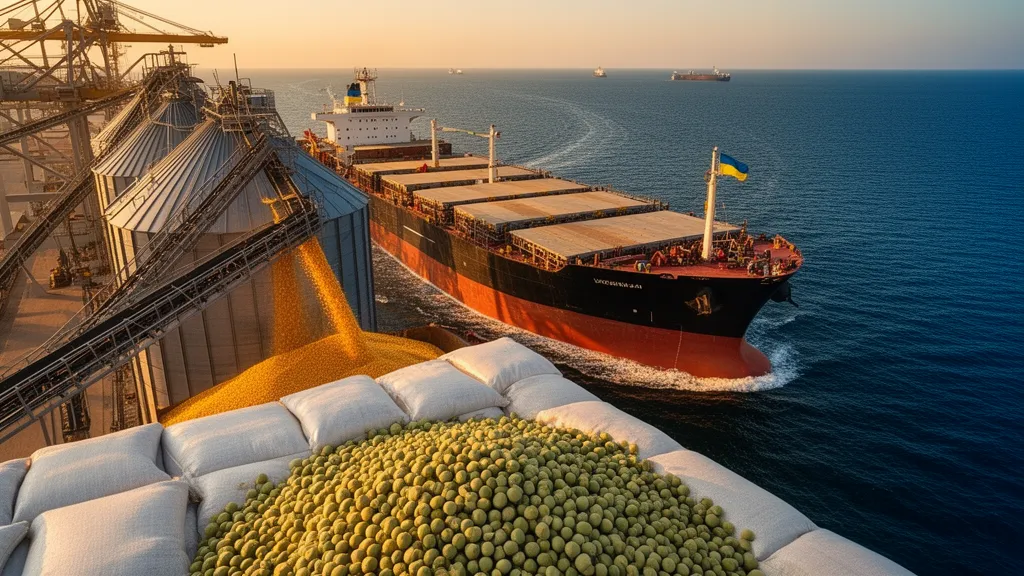
- Expansion: Ukraine opened 19 new agricultural export markets in 2025 across North America, Asia, the Balkans, and the Middle East despite ongoing war conditions.
- Product breadth: New access covers eggs, dairy, peas, fishery products, feed and non-food animal products, poultry, processed foods, and apples.
- High-value destinations: China, Canada, Oman, Kuwait, Malaysia, and Chile enhance Ukraine’s reach into higher-margin and long-haul markets.
- Freight impact: Neutral to bullish for Black Sea freight as longer-distance cargoes to Asia and North America could support rates if volumes materialize.
Ukraine’s New Agricultural Export Markets in 2025
Ukraine significantly expanded its agricultural export footprint in 2025, securing access to 19 new markets across North America, Asia, the Balkans, and the Middle East. This progress comes despite the operational and logistical disruptions stemming from the ongoing war, and reflects intensified efforts by Ukrainian authorities to diversify export channels beyond traditional European corridors.
Animal Products and Feed: Broadest Market Expansion
The animal product sector recorded the widest market gains. Feed and non-food animal products, including meat and bone meal, feather meal, fats, and processed animal protein, obtained access to Moldova, Turkey, Chile, Bosnia and Herzegovina, and Vietnam. These approvals broaden outlets for by-products of Ukraine’s livestock industry and support utilization of processing capacity.
Eggs and egg products made notable inroads. Albania and Canada opened their markets to Ukrainian shell eggs, while Malaysia approved imports of egg products. These moves extend Ukraine’s reach into both regional and high-income markets, enabling suppliers to target differentiated demand segments and diversify revenue.
Poultry exports also strengthened. Oman granted access for Ukrainian poultry meat and processed poultry products, expanding the country’s presence in the Gulf region. Georgia, meanwhile, opened its market for ready-to-eat composite products and dairy ingredients, supporting value-added exports and cross-border food industry linkages.
Malaysia further approved imports of Ukrainian milk and dairy products, offering an additional Asian outlet for higher-value dairy items and supporting the development of Ukraine’s processing sector.
Plant-Based, Dairy, and Fishery Exports: Strategic Asian and North American Access
Plant-based and fishery exports made strategic advances in key Asian and North American markets. China granted access for Ukrainian pea exports as well as wild-caught fishery products, including specified categories of aquatic bioresources. Entry into China is particularly important given its scale in both feed and food demand, and it offers Ukraine a route to deepen participation in Asian protein and pulse supply chains.
Canada approved imports of Ukrainian apples, a notable step for fruit exporters seeking to position in premium retail and wholesale segments in North America. This comes alongside Canada’s decision to open its market to Ukrainian eggs, underscoring growing trust in Ukrainian sanitary and phytosanitary controls.
Value-added demand is also expanding. Kuwait opened its market to processed food products from Ukraine, while Oman’s approvals for processed poultry further reinforce the trend toward higher-margin, branded, and ready-to-eat offerings in Middle Eastern markets.
Implications for Black Sea Freight and Trade Flows
The opening of 19 new markets is neutral to bullish for Black Sea freight demand. By diversifying exports beyond traditional EU routes, Ukraine reduces its dependence on short-haul overland corridors and rebalances its logistics mix toward seaborne trade. Access to distant destinations such as China, Canada, Chile, and Kuwait should, in principle, support freight rates through longer average voyage distances and more complex routing from Black Sea ports.
New approvals in Asia for peas, dairy, egg products, and fishery goods, alongside processed product demand in the Gulf, may generate additional vessel requirements if exporters can convert market access into consistent shipment programs. However, the actual freight impact will depend on realized export volumes, pricing competitiveness, and ongoing security and insurance constraints in the Black Sea region.
Traders and shipowners should monitor upcoming tender activity, customs data, and reported shipping fixtures to assess whether these newly opened markets translate into material cargo flows. If volumes ramp up, vessel availability could tighten and support freight pricing in selected Black Sea routes over the coming months.
Source: Market Data
Leave a Reply