
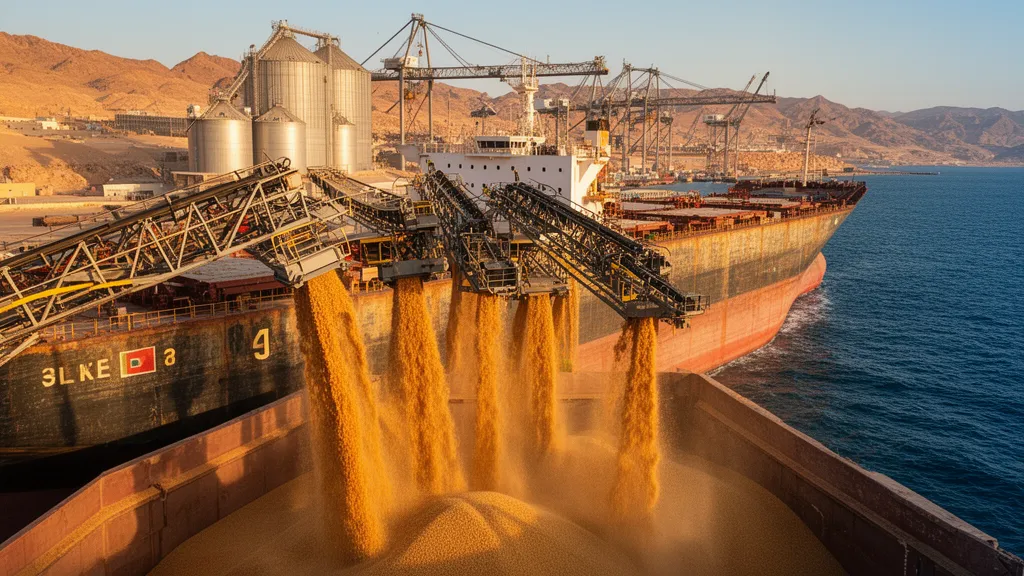
- Neutral: Jordan secured 60,000 tonnes of milling wheat at $260/tonne C&F, setting a competitive price benchmark for April delivery.
- Neutral: Only half of the planned 120,000 tonnes was purchased, signaling either price sensitivity or a staggered procurement strategy.
- Neutral: Tight bid spread of less than $5/tonne among five major traders highlights ample global wheat supply and intense competition.
Jordan Wheat Tender Overview
Jordan’s state grain buyer, MIT, concluded its January 6 international tender by purchasing 60,000 tonnes of random-origin milling wheat from operator Buildcom at $260 per tonne C&F. This volume represents 50% of the initially planned 120,000 tonne tender, indicating a partial fill of the original buying program.
The wheat is scheduled for delivery to the Port of Aqaba in a single shipment window between April 1 and 15, 2025. The random-origin specification allows suppliers from multiple regions, including the Black Sea, EU, and other exporters, to compete directly on price and logistics.
Tender Results and Price Competitiveness
| Participant | Offer Price (C&F Aqaba, $/tonne) |
Price vs. Lowest Bid ($/tonne) |
Outcome |
|---|---|---|---|
| Buildcom | $260.00 | Baseline | Winning bid (60,000 t purchased) |
| CHS | $261.95 | +$1.95 | Unsuccessful |
| Cargill | $262.95 | +$2.95 | Unsuccessful |
| COFCO | $263.00 | +$3.00 | Unsuccessful |
| Ameropa | $264.48 | +$4.48 | Unsuccessful |
Buildcom secured the tender with a $4.48–$4.95/tonne advantage over the highest-priced competitor, depending on rounding method, and a $1.95/tonne edge over the nearest offer. The narrow sub-$5/tonne range across all five bids underlines a well-supplied, highly competitive global wheat market.
Market Implications for Global and Black Sea Wheat
The $260/tonne C&F Aqaba price now acts as a reference benchmark for April 2025 delivery into the Middle East. For Black Sea exporters, the impact is broadly neutral: the random-origin terms mean they face direct competition from multiple export hubs, while the tight bid clustering confirms that alternative origins can match or closely track Black Sea pricing.
The decision by MIT to purchase only 60,000 tonnes out of the 120,000 tonnes initially sought may reflect either limited seller willingness at Jordan’s target price or a deliberate strategy to stagger buying in anticipation of stable or softer prices. Exporters should watch for a follow-up tender for the remaining 60,000 tonnes, which could add incremental demand and help clarify price direction into Q2 2025.
Source: Market Data
Leave a Reply