
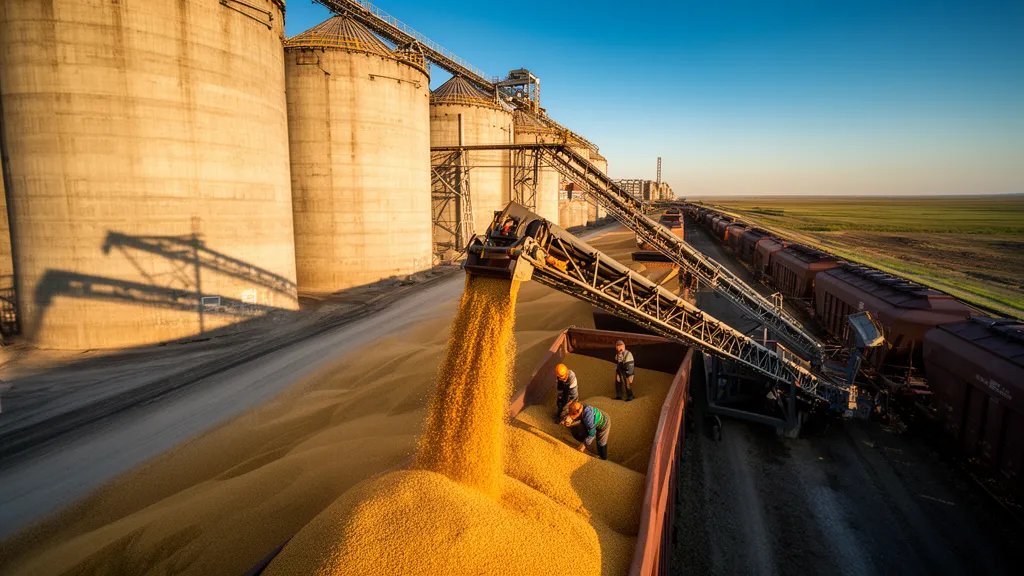
- Bullish: Kazakhstan’s crop exports surged 41.2% to $2.3 billion, supported by government financing and expanded market access across Central Asia, China, Russia, the Middle East, and Europe.
- Bearish: Increased Kazakh supply may intensify competition for freight capacity and pressure Black Sea-origin prices, particularly in wheat and sunflower oil.
Kazakhstan Crop Export Surge
Kazakhstan’s agricultural export sector recorded a sharp expansion, with crop shipments reaching $2.3 billion in value, a 41.2% year-on-year increase. Growth was driven by traditional export commodities including wheat, sunflower oil, animal feed, barley, and flaxseed, while livestock exports climbed 25.7% to $222.6 million, according to the Interdepartmental Commission of the Security Council.
More than 80% of Kazakhstan’s agricultural exports are concentrated in its top 10 markets. Key destinations include neighboring Central Asian countries, China, Russia, Middle Eastern importers, and European buyers, underscoring the country’s growing role as a regional grain and oilseed supplier.
Government Support and Market Access
To sustain and accelerate this export growth, the Kazakh government has expanded its trade and logistics framework. Around 119 billion tenge in financial support has been deployed to agricultural exporters via the Export Credit Agency and QazTrade JSC, improving liquidity and risk management for cross-border trade.
Additional momentum comes from free trade agreements between the Eurasian Economic Union (EAEU) and partners such as the UAE, Mongolia, and Indonesia. These arrangements open new channels for Kazakh-origin crops and processed products, further integrating the country into global agri-food supply chains.
Freight and Regional Logistics Impact
The 41% jump in crop exports is translating into higher freight demand across corridors linking Central Asia to China, Russia, the Middle East, and Europe. Rail networks and port-linked routes are likely to see tighter capacity as volumes from Kazakhstan rise, increasing competition for wagons and vessel space.
This tighter logistics landscape may influence freight rates and routing decisions for regional exporters, including those shipping from traditional Black Sea origins. Infrastructure investments in Kazakhstan suggest that elevated export volumes, and the associated freight demand, are likely to persist over the medium term.
Trade Flow and Price Risk Considerations
For grain and oilseed traders, Kazakhstan’s aggressive export strategy introduces a competitive dynamic, particularly in wheat and sunflower oil markets. As subsidized and credit-supported flows increase, some buyers in Central Asia, the Middle East, and selected European markets may partially shift away from Ukrainian and Russian suppliers.
Market participants should monitor export pace from Kazakhstan, freight spreads on key corridors, and any policy adjustments to support programs. These factors will help determine whether current volumes represent a one-off surge or the new baseline for regional trade flows.
| Indicator | Value | Change |
|---|---|---|
| Crop exports (value) | $2.3 billion | +41.2% |
| Livestock exports (value) | $222.6 million | +25.7% |
| Share of top 10 export markets | >80% | N/A |
| Government export support | 119 billion tenge | N/A |
Source: Market Data
Leave a Reply