
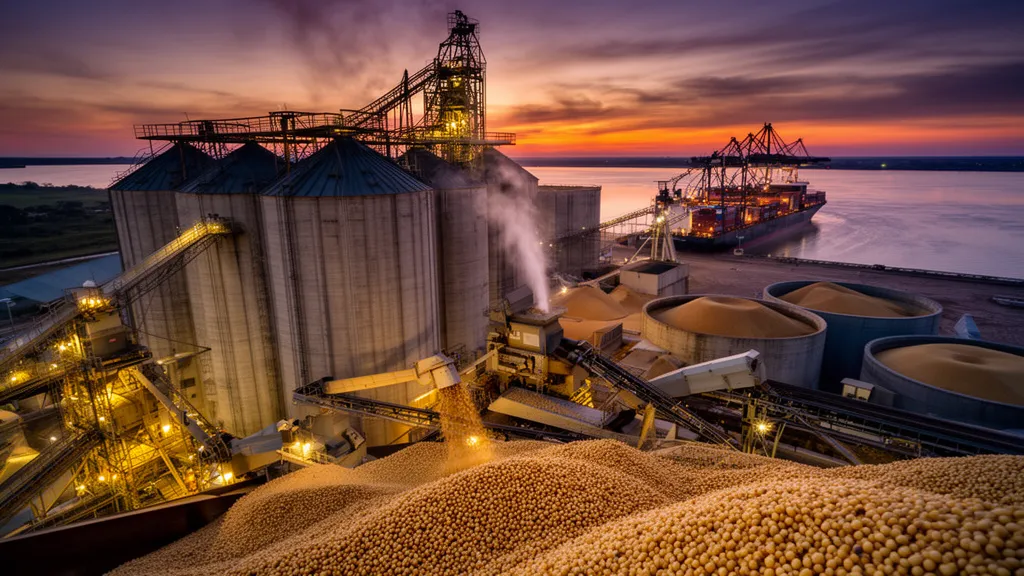
- Argentina’s soybean crush fell to 3.49 MMT in November, a 0.55 MMT month-on-month drop to a 3‑month low amid strong export demand and seasonal supply tightening.
- Meal and oil inventories declined sharply, with soybean meal stocks down 32% to 728,000 tonnes, tightening near-term product availability.
- Sunflower seed processing hit a 9‑month low at 306,000 tonnes, though cumulative volumes remain well above last year.
- Implications are neutral to slightly bearish for Black Sea soy complex, as reduced Argentine meal output may briefly support global prices while robust Chinese demand for beans challenges Black Sea export competitiveness.
Argentina Soybean and Sunflower Processing Overview
Argentina’s soybean processing volumes dropped to 3.49 million tonnes in November 2024, down from 4.04 million tonnes in October and marking a 3‑month low. Despite the monthly decline, crushing activity remained 2% above November 2023 levels, underscoring still-solid annual throughput.
The pullback in crushing reflects seasonal tightening in domestic soybean availability, alongside active raw bean exports, particularly to China. Year-to-date soybean processing through November reached 39.5 million tonnes, up from 38.5 million tonnes in the same period a year earlier.
Sunflower Seed Processing Trends
Sunflower seed processing also contracted notably, falling to a 9‑month low of 306,000 tonnes in November from 448,000 tonnes in October. However, cumulative sunflower processing over January–November totaled 4.37 million tonnes, significantly higher than 3.59 million tonnes in the corresponding period of the previous year.
Crush Product Stocks and Inventory Dynamics
The slowdown in processing and strong export pull have compressed inventories at Argentine crushing facilities. Soybean meal stocks at the start of December stood at 728,000 tonnes, sharply lower than 1.07 million tonnes a month earlier and below 873,000 tonnes in early December of the prior year. Soybean oil stocks edged down to 282,000 tonnes from 298,000 tonnes.
Sunflower complex inventories also tightened. Sunflower meal stocks decreased to 139,000 tonnes from 172,000 tonnes, while sunflower oil inventories dropped to 86,000 tonnes from 116,000 tonnes over the same period.
| Item | Latest Value | Previous Value | Reference Period |
|---|---|---|---|
| Soybean processing | 3.49 MMT | 4.04 MMT | Nov 2024 vs Oct 2024 |
| Soybean processing, YTD | 39.5 MMT | 38.5 MMT | Jan–Nov 2024 vs Jan–Nov 2023 |
| Sunflower processing | 306,000 t | 448,000 t | Nov 2024 vs Oct 2024 |
| Sunflower processing, YTD | 4.37 MMT | 3.59 MMT | Jan–Nov 2024 vs Jan–Nov 2023 |
| Soybean meal stocks | 728,000 t | 1,070,000 t | Early Dec 2024 vs early Nov 2024 |
| Soybean oil stocks | 282,000 t | 298,000 t | Early Dec 2024 vs early Nov 2024 |
| Sunflower meal stocks | 139,000 t | 172,000 t | Early Dec 2024 vs early Nov 2024 |
| Sunflower oil stocks | 86,000 t | 116,000 t | Early Dec 2024 vs early Nov 2024 |
Market Impact and Black Sea Competitiveness
From a global market perspective, Argentina’s reduced crushing and tighter meal stocks are neutral to slightly supportive for international soybean meal prices in the near term. This backdrop may open tactical opportunities for Black Sea exporters, particularly Ukraine and Russia, to increase meal shipments into markets that typically rely on Argentine supplies.
However, Argentina’s choice to prioritize raw soybean exports, driven by strong Chinese demand, highlights intensified competition on the bean export front. This could weigh on the competitiveness of Black Sea soybean exports into Asia, even as it potentially improves their relative position in the meal segment. Traders should closely track Argentine crush rates, Chinese buying patterns, and freight spreads when positioning in Black Sea soybeans and meals.
Source: Market Data
Leave a Reply