
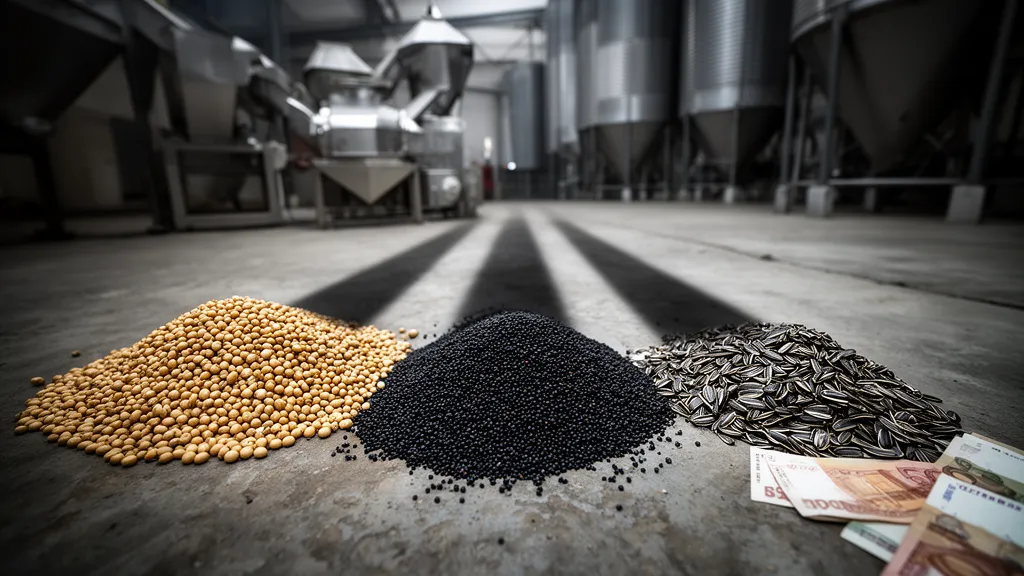
- Bearish: Russian soybean prices fell 9.8% month-on-month in November 2025 and are down 24.1% year-on-year amid weak processing demand.
- Bearish: Rapeseed prices slipped 0.5% on the month and 8.8% year-on-year, reflecting deteriorating margins in the crushing sector.
- Mixed: Sunflower seed prices rose 1.1% in November but remain 10.7% below year-ago levels, signaling only tentative support.
- Macro headwind: A manufacturing PMI of 48.1 in December 2025 indicates continued contraction and limited near-term recovery in domestic oilseed consumption.
Russian Oilseed Market Overview
Russian oilseed prices moved mostly lower in November 2025, pressured by subdued demand from industrial processors and a weakening macro backdrop. Soybeans and rapeseed registered notable monthly and annual declines, while sunflower seeds posted a small monthly gain but remained significantly below year-earlier levels.
Oilseed Prices and Monthly Changes
| Commodity | Average Price (Nov 2025, RUB/ton) | MoM Change vs Oct 2025 | YoY Change vs Nov 2024 |
|---|---|---|---|
| Soybeans | 31,003 | -9.8% | -24.1% |
| Rapeseed | 36,967 | -0.5% | -8.8% |
| Sunflower seed | 38,090 | +1.1% | -10.7% |
In November 2025, Russian industrial enterprises paid an average of 31,003 rubles per ton for soybeans, down 9.8% from October and 24.1% below November 2024, according to Rosstat data reported by Grain On-Line. Rapeseed prices edged 0.5% lower on the month to 36,967 rubles per ton, an 8.8% decline year-on-year. Sunflower seeds diverged from the broader bearish trend, rising 1.1% month-on-month to 38,090 rubles per ton, though still 10.7% cheaper than a year earlier.
Macro Backdrop and Manufacturing Weakness
The broader Russian manufacturing sector remains under pressure, with the PMI at 48.1 in December 2025, marking the seventh consecutive month of contraction. Output fell at the fastest pace since March 2022, driven by weak demand and reduced customer purchasing power. At the same time, cost inflation accelerated to its highest level since March, while business confidence dropped to its lowest since May 2022, creating a challenging environment for industrial oilseed consumers.
Market Analysis and Outlook
The sustained decline in soybean and rapeseed prices is broadly bearish for Black Sea oilseeds and highlights deteriorating demand from the Russian processing sector. Weak PMI readings and shrinking manufacturing activity point to limited near-term recovery in domestic crush volumes. Although sunflower seeds showed a modest monthly rebound, the negative annual trend underscores continued softness in overall oilseed pricing. Rising input costs against falling selling prices are likely to compress crush margins and curb processor appetite for raw seeds. Market participants should watch whether continued growth in grain rail loadings spills over into improved oilseed export logistics, which could partially offset sluggish domestic demand.
Source: Market Data
Leave a Reply