
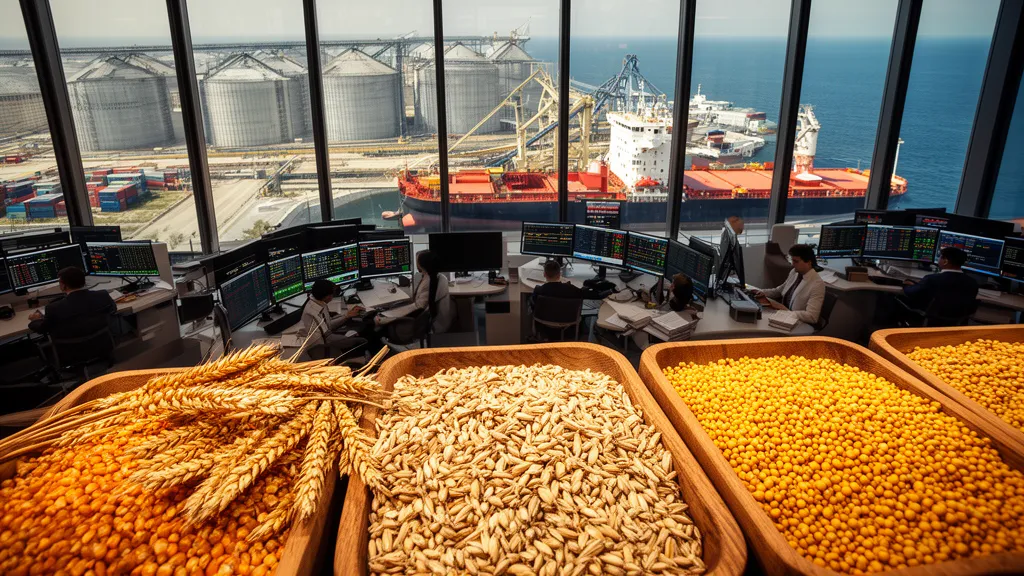
- Grains Lead: Russian grain contracts dominate exchange trading with 4.4 million tons sold, reinforcing the country’s leadership in global wheat, corn, and barley markets.
- Diversifying Products: Oilseeds (1.3 million tons), sugar (1.2 million tons), and newly launched meat trading signal broader agricultural market formalization.
- Stronger Transparency: Mandatory OTC contract reporting and potential volume requirements aim to improve price benchmarks and export duty calculations.
- Regulatory Risk: Fines of 300,000–500,000 rubles for non-compliance underscore tighter state oversight of agricultural trading activity.
Russian Agricultural Exchange Expansion
The Federal Antimonopoly Service (FAS) of Russia reports robust growth in agricultural exchange trading over the past five years, with grains emerging as the dominant product group. Wheat, corn, and barley together account for 4.4 million tons in cumulative exchange sales, underlining Russia’s central role in Black Sea grain flows.
Beyond grains, the exchange has accumulated 1.3 million tons of oilseeds, including soybeans, rapeseed, and sunflower. Sugar trading has reached 1.2 million tons, while the 2025 launch of meat contracts has added 18,800 tons of poultry, pork, and turkey to the platform.
Trading Volumes by Commodity Group
| Commodity Group | Exchange Volume (tons) | Notes |
|---|---|---|
| Grains (wheat, corn, barley) | 4,400,000 | Largest share of exchange turnover |
| Oilseeds (soybeans, rapeseed, sunflower) | 1,300,000 | Key input for vegetable oils and meal |
| Sugar | 1,200,000 | Solid participation in structured trading |
| Meat (poultry, pork, turkey) | 18,800 | Launched on the exchange in 2025 |
| Product Types Listed | 70+ | Range of agricultural commodities available |
| Regional Delivery Bases | 45 | Supports broad geographic coverage |
Regulatory Framework and OTC Reporting
FAS is considering requirements that would link exchange sales volumes to economic concentration monitoring, using them to develop national price indicators. These benchmarks are particularly important for export-oriented supply chains and for assessing market power within Russia’s agricultural sector.
The agency also enforces mandatory submission of over-the-counter (OTC) contract data by legal entities to the exchange. This information feeds into the calculation of price indicators used to determine export duties, helping align official benchmarks with actual traded levels across the market.
| Regulatory Measure | Details | Market Impact |
|---|---|---|
| Mandatory OTC Reporting | Legal entities must submit OTC contract data to the exchange | Improves transparency and benchmark reliability |
| Use of Price Indicators | Indicators used in export duty calculations | Direct influence on export pricing and competitiveness |
| Non-Compliance Fine (Minimum) | 300,000 rubles | Financial incentive to comply with reporting rules |
| Non-Compliance Fine (Maximum) | 500,000 rubles | Heightened regulatory and cost risk for violators |
Market Impact and Sentiment
Market sentiment appears neutral to slightly bullish. The combination of growing exchange volumes and broader product coverage enhances price discovery for Russian agricultural exports, particularly grains and oilseeds. More reliable benchmarks can support liquidity and hedging, potentially making Russian-origin supplies more predictable for international buyers.
At the same time, stricter enforcement and higher transparency requirements may expose more of the market to regulatory oversight and export duty adjustments. This could affect margins for some participants but should strengthen the integrity and global relevance of Russian agricultural price indicators over the medium term.
Source: Market Data
Leave a Reply