
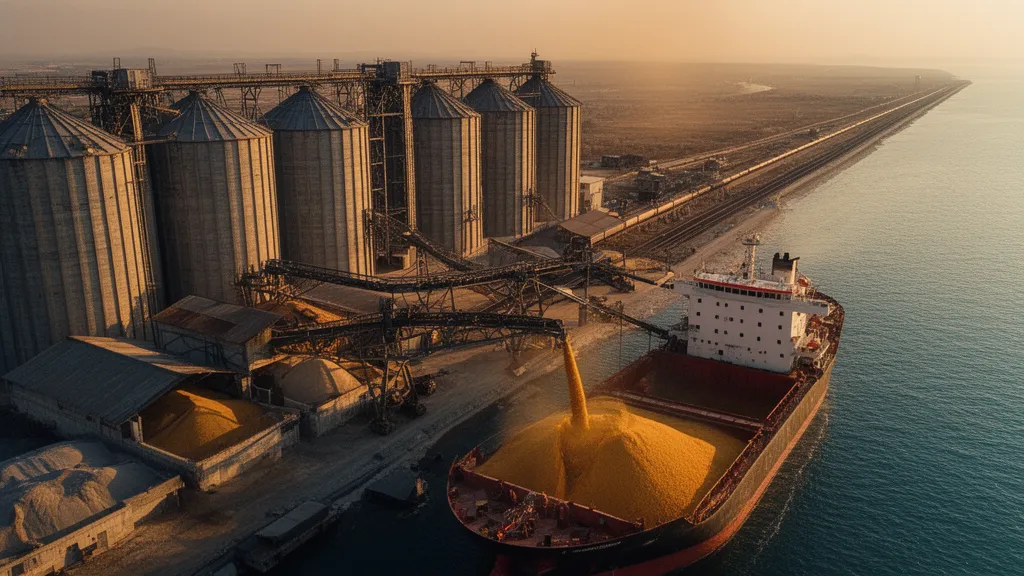
- Bearish: Ukraine’s agricultural export revenues declined by €2.2 billion as of December 1, 2025, with 95% of the loss linked to reduced access to the EU market.
- Bearish: Unpredictable EU trade policy for Ukrainian agricultural imports is undermining pricing visibility and forward freight planning.
- Neutral/Structural: Ukraine must implement 20 EU production standards by end-2028, creating both compliance costs and long-term integration opportunities.
- Bearish: Near-term sentiment is negative for EU-bound Ukrainian agricultural freight, with elevated volatility expected until regulatory clarity improves.
Market Update
Ukraine’s agricultural export revenues dropped by €2.2 billion as of December 1, 2025, according to Oleksandra Avramenko, Chair of the UCAB Committee on European Integration, speaking at the “Doing Agribusiness in Ukraine” conference on December 22. Approximately 95% of these losses are tied to reduced exports to the European Union, underscoring the centrality of the EU market for Ukrainian agribusiness.
Avramenko highlighted the absence of a predictable and stable EU trade policy framework for Ukrainian agricultural imports as the primary factor behind the revenue decline. The uncertainty around quotas, safeguard measures, and regulatory treatment is weighing on trade flows, pricing decisions, and forward contracting.
Despite the near-term setback, the European Commission’s latest enlargement report acknowledges Ukraine’s progress in modernizing its agricultural sector, particularly in food safety. As part of its EU integration path, Ukraine is required to adopt 20 EU production standards by the end of 2028, which will necessitate significant upgrades in production practices, traceability, and quality control.
UCAB is pushing for transition periods and compensatory mechanisms to ease the burden on domestic producers and mitigate integration risks for the European market. Negotiating working groups have been set up across sectors, and a fifth negotiating cluster focused on agriculture may open before year-end, potentially providing a clearer roadmap for regulatory alignment and market access.
Export and Policy Impact Overview
| Indicator | Value | Notes |
|---|---|---|
| Total decline in agricultural export revenues | €2.2 billion | As of December 1, 2025 |
| Share of losses linked to EU market | 95% | Concentrated in EU trade corridor |
| EU production standards to be adopted | 20 standards | Deadline: End of 2028 |
Logistics and Freight Market Analysis
The €2.2 billion decline in export revenues presents a material challenge for Ukrainian agricultural freight flows, particularly along the EU corridor and via Black Sea routes that are heavily geared toward European demand. With 95% of losses originating from reduced EU exports, traditional European logistics channels may experience lower utilization and greater rate volatility in the near term.
The lack of predictable EU trade policy introduces significant uncertainty for traders and shippers managing forward freight commitments. Pricing of long-term contracts, vessel scheduling, and capacity planning through EU-linked ports and overland routes are all made more complex by shifting regulatory and market access conditions.
Market participants should monitor the potential reorientation of Ukrainian export flows toward non-EU destinations as Ukraine progresses toward adopting 20 EU production standards by 2028. During this transition period, differential regulatory requirements and risk profiles across destinations may make alternative markets relatively more attractive, reshaping route economics, port utilization, and freight spreads between EU and non-EU corridors.
Sentiment: Bearish for EU-bound Ukrainian agricultural freight in the short to medium term, with heightened volatility expected until a clearer and more stable EU trade framework is established.
Source: Market Data
Leave a Reply