
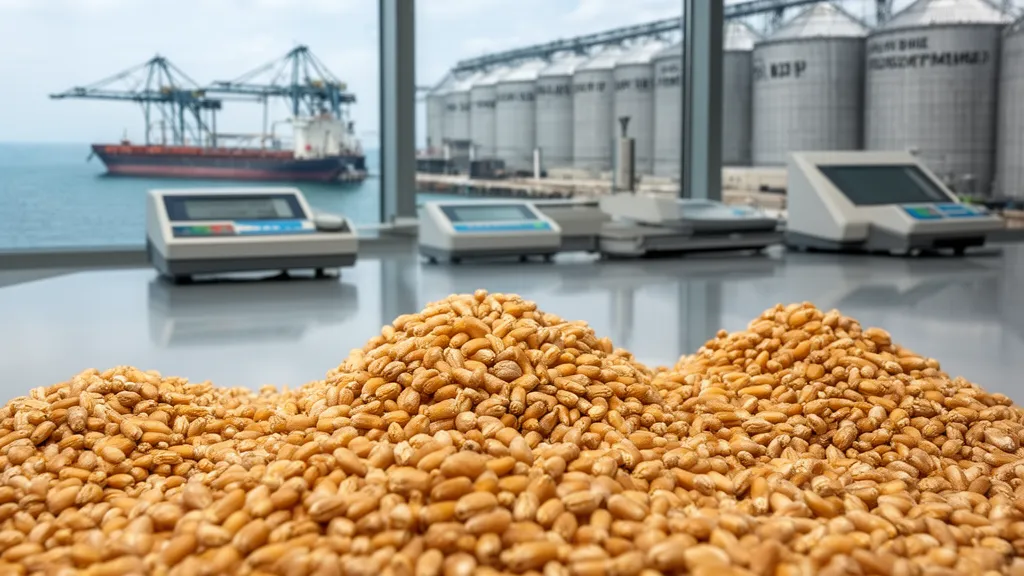
- Policy Shift: Russia reinstates a wheat export duty of 109.1 rubles/ton for December 24–30, while keeping barley and corn duties at zero.
- Export Mix: Zero duties on barley and corn enhance the competitiveness of Russian feed grain exports versus wheat.
- Quality Profile: Moscow Region wheat is dominated by Class 4 (48.4%) with solid protein and gluten levels, supporting milling and export demand.
- Yield Performance: Average regional wheat yields of 40.9 c/ha, led by winter wheat at 42.7 c/ha, underpin stable supply.
Russia Reinstates Wheat Export Duty
Russia’s Ministry of Agriculture will reintroduce a wheat export duty of 109.1 rubles per ton for the period December 24–30, 2025. The duty is based on an indicative export price of $227.9 per ton, reflecting authorities’ focus on managing domestic wheat prices as the season advances.
In contrast, export duties for barley and corn will remain at zero for the same period. These zero rates are calculated from indicative prices of $219.2 per ton for barley and $202.0 per ton for corn, preserving a cost advantage for feed grains in international markets.
Export Duty and Price Indicators
| Commodity | Indicative Price (USD/ton) | Export Duty (Rub/ton) | Duty Status (Dec 24–30, 2025) |
|---|---|---|---|
| Wheat | $227.9 | 109.1 | Reinstated |
| Barley | $219.2 | 0 | Zero duty |
| Corn | $202.0 | 0 | Zero duty |
Moscow Region Wheat Quality and Yields
State grain monitoring in the Moscow Region covered over 383,000 tonnes of wheat across 508 samples from 25 municipalities. Class 4 wheat dominates the quality profile with 185,500 tonnes (48.4%), followed by Class 5 at 115,100 tonnes (30%) and Class 3 at 80,400 tonnes (21%). Non-compliant grain under GOST standards totals 2,200 tonnes (0.6%).
| Wheat Category | Volume (tonnes) | Share of Total (%) |
|---|---|---|
| Class 3 | 80,400 | 21.0% |
| Class 4 | 185,500 | 48.4% |
| Class 5 | 115,100 | 30.0% |
| Non-compliant (GOST) | 2,200 | 0.6% |
| Total Monitored | 383,200 | 100.0% |
Quality indicators show crude gluten ranging from 12% to 28% and protein content from 9% to 22%, adequate for standard milling wheat specifications. Average regional yields reached 40.9 centners per hectare, with winter wheat at 42.7 c/ha and spring wheat at 36.4 c/ha. Key producing districts include Zaraysk, Serebryanye Prudy, and Lotoshino.
| Indicator | Value |
|---|---|
| Average yield (all wheat) | 40.9 c/ha |
| Winter wheat yield | 42.7 c/ha |
| Spring wheat yield | 36.4 c/ha |
| Crude gluten range | 12% – 28% |
| Protein content range | 9% – 22% |
Market Implications
The modest wheat export duty of 109.1 rubles per ton (roughly $1.10–1.20, depending on the exchange rate) is unlikely to materially alter Russian FOB competitiveness, but it underscores policymakers’ priority of stabilizing domestic wheat prices. Keeping barley and corn at zero duty enhances the relative attractiveness of Russian feed grains in export channels.
The Moscow Region’s dominance of Class 4 wheat and solid protein and gluten levels support both domestic milling demand and export programs, particularly for standard Russian milling wheat. With stable yields and adequate quality, Russia remains well positioned to supply global buyers even as minor policy adjustments fine-tune export flows.
Source: Market Data
Leave a Reply