
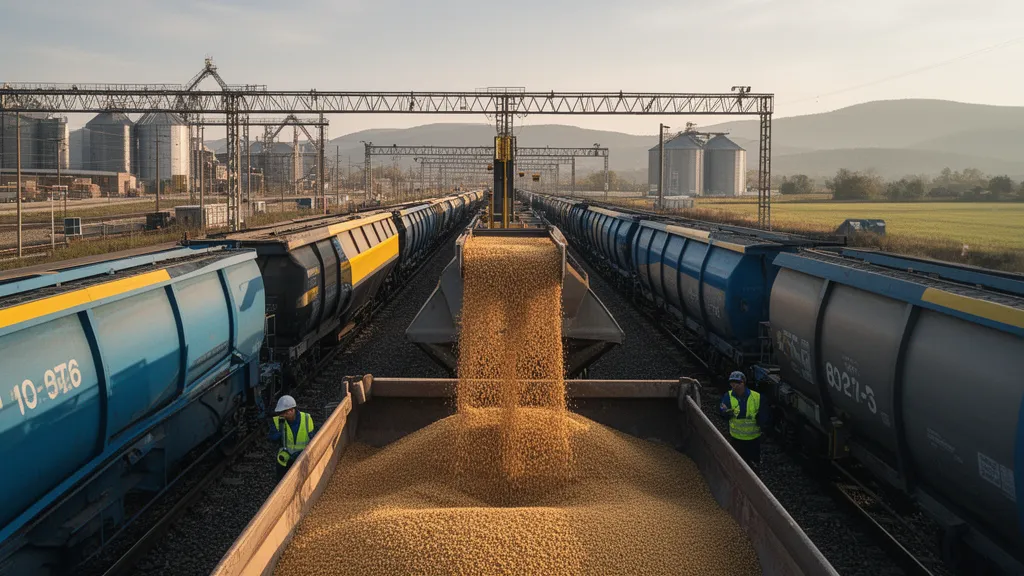
- Neutral to slightly bullish: Rail grain exports via EU border crossings have increased by around 34 cars per day versus November, led by stronger flows through Slovakia and Hungary.
- Logistical resilience: Higher rail capacity is partially offsetting constrained seaborne routes, supporting export continuity but not yet restoring pre-conflict shipment levels.
- Mixed regional dynamics: A marginal decline at the Romania crossing is outweighed by gains through Hungary, Slovakia, and Poland.
Ukrainian Rail Grain Exports Gain Momentum at EU Borders
Ukraine has expanded grain rail export capacity through key European Union border crossings in the first half of December, according to Valeriy Tkachev, Deputy Director of the Department of Transportation Technology and Commercial Work at JSC Ukrzaliznytsia. The shift underscores improving logistics resilience as the country continues to reroute grain flows away from disrupted seaborne corridors.
Border Crossing Performance
As of December 17, average daily transfers of grain rail cars showed notable growth at the Hungary, Slovakia, and Poland crossings, with a modest contraction at the Romania border. Slovakia recorded the strongest absolute increase, while Hungary maintained the highest daily throughput.
| Border Crossing | Daily Cars (Dec) | Change vs November |
|---|---|---|
| Hungary | 56.0 | +7.8 |
| Slovakia | 36.0 | +14.9 |
| Poland | 20.4 | +13.1 |
| Romania | 10.0 | -1.4 |
The combined net increase across the three growing corridors is approximately 34 additional grain cars per day versus November, signaling a meaningful uplift in rail-based export capacity.
Market Impact and Outlook
The logistical upgrades at EU border crossings are neutral to slightly bullish for Ukrainian grain export flows and, by extension, for regional supply dynamics. Higher rail throughput helps offset limitations in Black Sea seaborne shipments, but aggregate export volumes still trail pre-conflict levels.
The small decline in Romania-bound flows does little to undermine the broader improvement, with Hungary and Slovakia now serving as increasingly important gateways. Traders should track whether these higher daily car counts are sustained and whether additional infrastructure or regulatory adjustments unlock further capacity into early 2025.
Source: Market Data
Leave a Reply