
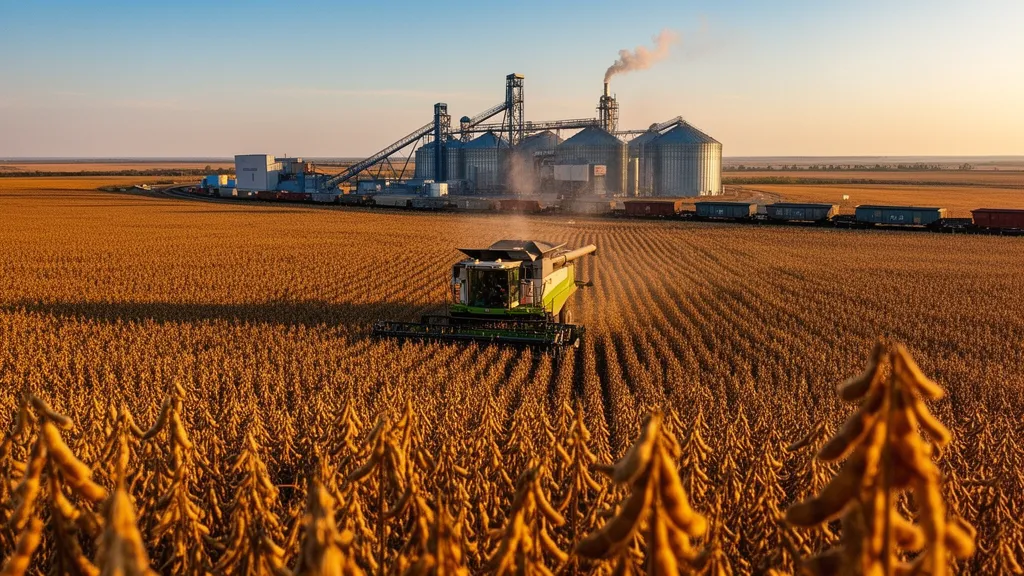
- Bearish Black Sea imports: Russia’s 2025 soybean crop is forecast up nearly 30% to as high as 9.3 million tons, slashing import needs and weighing on regional import demand.
- Bullish export potential: Strong production gains in Amur, Primorsky, Tambov, Belgorod, and Kursk could reposition Russia as a net soybean/meal exporter into Asian, European, and Middle Eastern markets.
- Structural shift: Soybean imports plunged 63% to a record-low 150,000 tons in Sep–Nov 2024, reducing reliance on GMO beans and supporting domestic crushing margins.
Russia Soybean Market Update
AB-Center analysts project Russia’s 2025 soybean harvest at 8.98–9.3 million tons, implying almost 30% year-on-year growth versus 2024. The baseline scenario covers 21 key regions that represent 85.3% of harvested area, with their combined output expected to rise to 8.07 million tons from 5.97 million tons last season.
The largest absolute gains are concentrated in a handful of core producing regions. The Far Eastern Amur Region leads with an additional 322,700 tons, bringing its total to 1.74 million tons. Central Russia’s Tambov Region is close behind, adding 321,200 tons to reach 835,100 tons, while Altai Krai in Siberia is seen up 250,100 tons for a total of 700,000 tons.
Further sizable increases are projected in Primorsky Krai (+211,900 tons to 424,900 tons), Belgorod Region (+160,700 tons to 681,000 tons), Oryol Region (+136,800 tons to 550,000 tons), and Kursk Oblast (+113,000 tons to 908,300 tons). These increments together underpin the national production surge and materially alter Russia’s soybean balance sheet.
Production and Regional Growth Breakdown
| Region | 2024 Production (tons) | 2025 Forecast (tons) | Change (tons) |
|---|---|---|---|
| Russia (national, low estimate) | ~6,900,000 | 8,980,000 | +2,080,000 |
| Russia (national, high estimate) | ~6,900,000 | 9,300,000 | +2,400,000 |
| 21 key regions (aggregate) | 5,970,000 | 8,070,000 | +2,100,000 |
| Amur Region | 1,417,300 | 1,740,000 | +322,700 |
| Tambov Region | 513,900 | 835,100 | +321,200 |
| Altai Krai | 449,900 | 700,000 | +250,100 |
| Primorsky Krai | 213,000 | 424,900 | +211,900 |
| Belgorod Region | 520,300 | 681,000 | +160,700 |
| Oryol Region | 413,200 | 550,000 | +136,800 |
| Kursk Oblast | 795,300 | 908,300 | +113,000 |
Trade Flows and Import Dynamics
Expanded domestic output has sharply curtailed import demand. Soybean imports for the September–November 2024 period fell 63% year-on-year to a record low of 150,000 tons. This contraction is particularly notable in the segment of GMO soybeans for processing, signaling a structural pivot toward locally sourced raw material for the crushing industry.
| Period | Soybean Imports (tons) | Year-on-Year Change |
|---|---|---|
| Sep–Nov 2023 | ~405,000 | — |
| Sep–Nov 2024 | 150,000 | -63% |
Price Outlook and Market Impact
The projected 2.1–2.4 million ton increase in soybean output is broadly bearish for Black Sea import demand and for traditional external suppliers into Russia. With higher domestic availability, crushers can run at elevated utilization rates using local beans, limiting upside in import premiums and potentially pressuring regional soybean complex values.
At the same time, the geography of production growth enhances Russia’s export optionality. Gains in Amur and Primorsky reduce logistical barriers to serving Asian buyers, while expansion in Tambov, Belgorod, and Kursk improves access to European and Middle Eastern markets via Black Sea and overland routes. If Russian exporters translate the supply surge into aggressive pricing on soybeans and soybean meal, this could intensify competition for Ukraine and other regional origins in 2025–2026.
Overall, the balance of risks skews bearish for import-dependent players around the Black Sea and neutral-to-bullish for Russia’s regional export footprint, with price direction hinging on realized yields, logistics, and export policy decisions through the 2025 marketing year.
Source: Market Data
Leave a Reply