
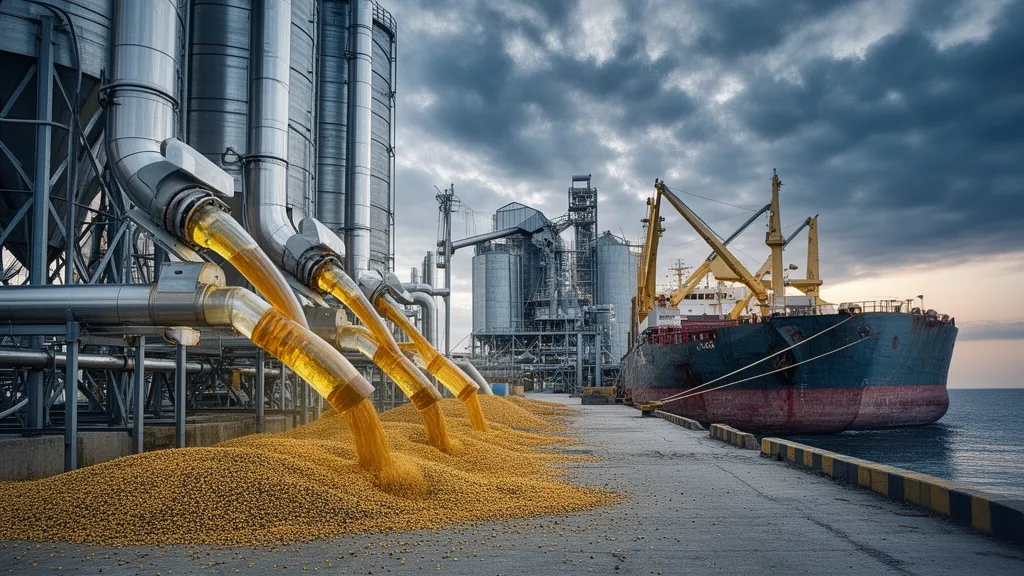
- Bearish Black Sea sunflower oil: FOB Black Sea prices dropped $30/t day-on-day to $1,240/t, marking the sharpest daily decline among major vegetable oils.
- Regulatory clarity in Russia: FAS confirmed the 2026 VAT hike excludes socially important foods, which retain the 10% rate, limiting VAT-driven price increases.
- Mixed oilseed complex: Rapeseed oil and meal rallied to weekly highs, while soybean products retreated to new weekly lows, signaling divergent fundamentals.
- Margin squeeze risk: Sunflower oil weakness versus firmer meal prices suggests pressure on crushing margins that could eventually curb processing rates.
- Market bias: Bearish for Black Sea sunflower oil; neutral for domestic Russian grain and food markets given VAT policy stability.
Market Update: Black Sea Sunflower Oil and Oilseed Complex
Black Sea sunflower oil prices came under strong pressure on December 17, 2025, with FOB Black Sea offers for December–January loading falling to $1,240/t, down $30/t from $1,270/t the previous day. This was the steepest single-day move across the major vegetable oil benchmarks, underlining persistent competition among Black Sea exporters amid ample global supplies.
Russia’s Federal Antimonopoly Service (FAS) moved to pre-empt VAT-related price hikes in the domestic food market. The agency warned large retail chains such as Magnit, Auchan, O’Key, and Lenta that the upcoming VAT hike from 20% to 22% on January 1, 2026, does not apply to socially important food products, which will retain the preferential 10% rate. FAS letters to the Association of Retail Companies and the Union of Independent Networks of Russia clarified that any retailer attempts to justify food price increases by citing the VAT change will be deemed unjustified.
Across the broader oilseed complex, performance was mixed. Rapeseed oil FOB Netherlands rallied sharply, while rapeseed meal FOB EU also pushed to weekly highs. In contrast, the soybean complex weakened, with Brazilian and US soybean meal, as well as soybeans FOB Brazil, all slipping to new weekly lows. Sunflower meal CIF France edged higher, modestly supporting crush margins despite the pronounced weakness in sunflower oil.
Price Moves Across Key Oilseed Products
| Commodity | Location / Basis | Price | Change (Day-on-Day) | Notes |
|---|---|---|---|---|
| Sunflower oil | FOB Black Sea (Dec/Jan) | $1,240/t | – $30.00/t | Sharpest daily decline among major vegoils |
| Rapeseed oil | FOB Netherlands | $1,285.36/t | + $38.84/t | Rallied to weekly highs |
| Rapeseed meal | FOB EU | $211.29/t | + $7.21/t | Reached weekly high |
| Soybean meal | FOB Brazil | $333.62/t | – $6.87/t | Weekly low |
| Soybean meal | CBOT (US) | $328.71/t | – $4.63/t | New minimum |
| Soybeans | FOB Brazil | $405.26/t | – $3.14/t | Weaker alongside soymeal |
| Sunflower meal | CIF France (May) | $258.25/t | + $3.14/t | Stronger, supporting crush margins |
Analysis and Market Bias
The $30/t slide in Black Sea sunflower oil underscores ongoing pressure on Ukrainian and Russian export offers, likely tied to competitive pricing in a well-supplied global vegoil market. Concurrent softness in soybean products points to broader bearish sentiment across oilseeds, even as rapeseed’s outperformance highlights selective demand for specific origins and products.
FAS’s intervention on VAT policy removes a key source of uncertainty in Russia’s domestic food market. By ring-fencing socially important foods at a 10% VAT rate despite the headline increase to 22%, regulators are limiting VAT-driven inflation. For Black Sea exporters, this may temper expectations of a domestic price surge that could have altered export availability or netbacks, leaving the outlook for Russian grain and food markets broadly neutral.
The divergence between weaker sunflower oil and firmer sunflower meal indicates that crush margins remain tight. If this pattern persists, processors may be forced to reassess throughput, which could gradually curb supply and stabilize prices. For now, the directional bias for Black Sea sunflower oil remains bearish, while domestic Russian grain and food markets appear neutral given clearer VAT rules heading into 2026.
Source: Market Data
Leave a Reply