
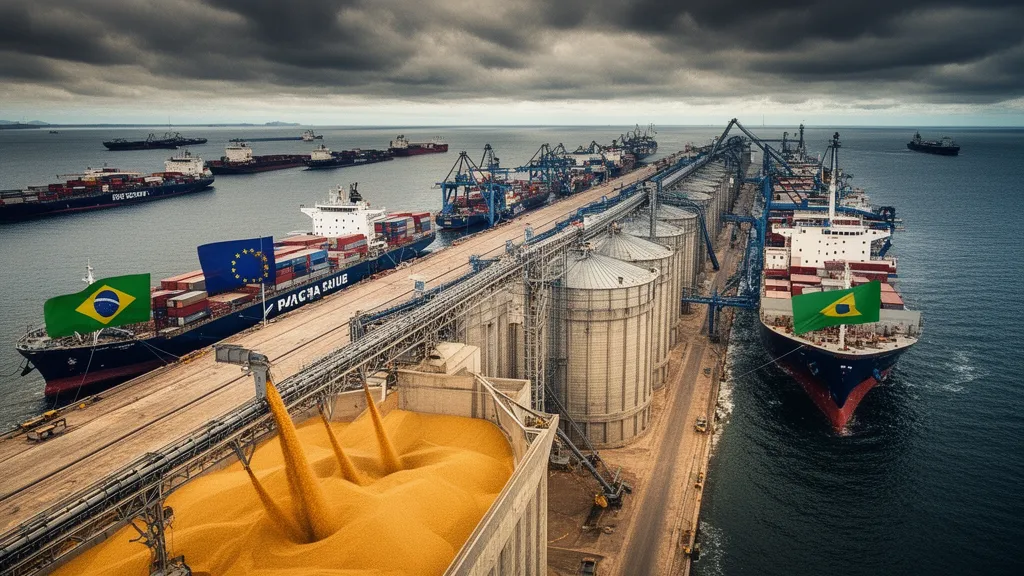
- EU Tightens Safeguards: European Parliament committee backs stricter and faster safeguard rules on Mercosur agricultural imports, lowering the trigger threshold to a 5% average rise over three years for sensitive products.
- Faster Investigations: Proposed timelines for safeguard probes are cut in half, to three months for standard and two months for sensitive products, with scope to require Mercosur exporters to meet EU production standards.
- Russian Export Surge: Moscow Region’s oil and fat product exports jumped 64.5% year-on-year to 98,700 tons in January–November 2025, with solid growth in meat and dairy shipments.
- Expanding Market Reach: The region now exports to 78 countries, led by China and Belarus, with rapid volume growth into Uzbekistan and Saudi Arabia.
- Market Impact: Neutral to slightly bearish for Black Sea exporters as tighter EU controls on Mercosur may redirect South American flows into Asia and the Middle East, intensifying competition where Russian volumes are already rising.
Market Update
The European Parliament’s Committee on International Trade has moved to reinforce controls on agricultural imports from Mercosur countries (Brazil, Argentina, Uruguay, and Paraguay). Lawmakers voted to lower the threshold for triggering safeguard investigations on sensitive agricultural products from the European Commission’s proposed 10% annual import growth to a 5% average increase over three consecutive years.
Under the proposal, investigation timelines would be significantly shortened: from six to three months for standard agricultural products and from four to two months for sensitive categories. The committee also backed amendments enabling safeguard measures to require Mercosur exporters to comply with EU production standards as a condition for market access.
The package now awaits approval at the December 15–18 plenary session of the European Parliament. If endorsed, it will form the Parliament’s mandate for inter-institutional negotiations with EU governments, potentially reshaping how agricultural trade with Mercosur is monitored and restricted in periods of import surges.
In parallel, Russia’s Moscow Region has reported robust growth in agricultural exports through November 2025. Shipments of oil and fat products climbed 64.5% year-on-year to 98,700 tons. Meat exports reached 260,000 tons, up 15.6%, while dairy exports rose 3.3% to 63,100 tons over the same period.
The Moscow Region now supplies agricultural products to 78 countries, with China and Belarus remaining the principal destinations. Emerging markets are posting some of the fastest growth: exports to Uzbekistan increased by more than 50% to nearly 54,000 tons, while shipments to Saudi Arabia surged 85.7% to around 30,000 tons.
Export Volumes by Product and Destination
| Category / Destination | Period | Volume (tons) | Year-on-Year Change |
|---|---|---|---|
| Oil & fat products (Moscow Region) | Jan–Nov 2025 | 98,700 | +64.5% |
| Meat (Moscow Region) | Jan–Nov 2025 | 260,000 | +15.6% |
| Dairy (Moscow Region) | Jan–Nov 2025 | 63,100 | +3.3% |
| Exports to Uzbekistan | Jan–Nov 2025 | ~54,000 | > +50% |
| Exports to Saudi Arabia | Jan–Nov 2025 | ~30,000 | +85.7% |
Analysis
Neutral to slightly bearish for Black Sea exports. Stricter and faster EU safeguards on Mercosur imports could divert some South American agricultural flows away from Europe and into alternative outlets, notably in Asia and the Middle East where Black Sea exporters are already active. This redirection would likely increase competition in those regions, putting mild pressure on margins and market share for Black Sea origins.
At the same time, Moscow Region’s strong export performance to Central Asia and Saudi Arabia points to deepening penetration in high-growth markets. The surge in oil and fat products, along with steady gains in meat and dairy, suggests Russian suppliers are consolidating their presence, which could help cushion any downside from heightened competition triggered by EU policy shifts. Traders should watch the December plenary vote closely, as the final shape of the safeguard regime will influence trade routes, contract structures, and relative competitiveness across origins in 2025.
Source: Market Data
Leave a Reply