
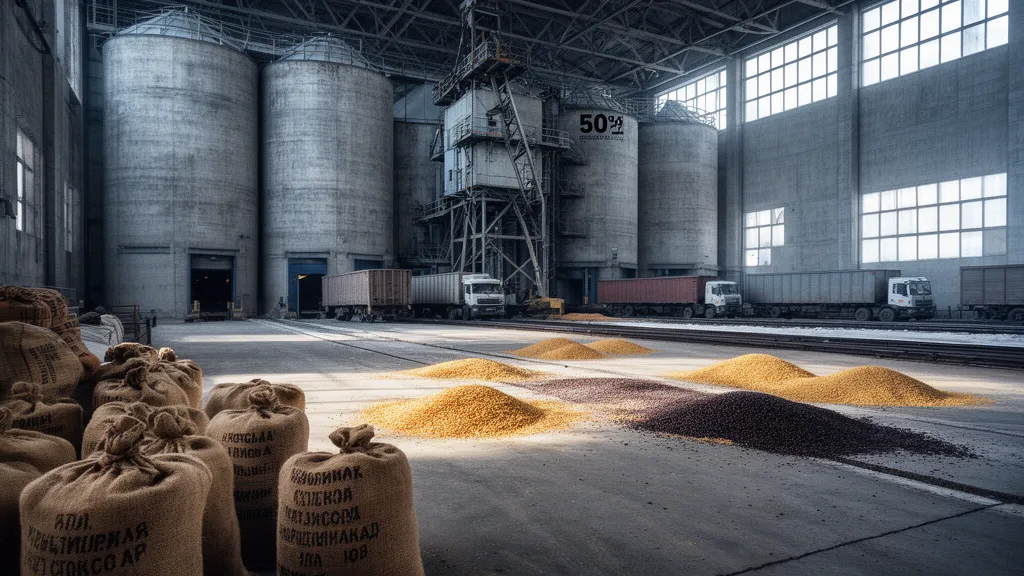
- Bearish for volumes: Bashkortostan’s grain and oilseed exports fell by roughly 50% year-on-year, from 401,600 tons in 2024 to just over 200,000 tons in 2025.
- Neutral for quality: All export batches fully met EU, EAEU, and destination country phytosanitary standards with zero detections of quarantine organisms.
- Mildly bearish for freight: Lower interior Russian export flows are slightly negative for Black Sea freight demand, though the impact is limited given the region’s small share of total Russian exports.
Bashkortostan Grain Export Snapshot
The Rosselkhoznadzor Office for the Republic of Bashkortostan processed just over 200,000 tons of grain, oilseeds, and grain products for export between January 9 and December 9, 2025. This compares with 401,600 tons over the same period in 2024, indicating a near 50% decline in certified export volumes despite stable compliance with international quality standards.
| Indicator | Jan–Dec 2024 | Jan–Dec 2025 | Change |
|---|---|---|---|
| Export volume (tons) | 401,600 | 200,000+ | ≈ -50% |
| Phytosanitary certificates issued | 8,200 | 4,500 | ≈ -45% |
Commodity Breakdown
| Commodity | Export Volume (tons) |
|---|---|
| Wheat | 42,700 |
| Flax | 41,000 |
| Barley | 16,000 |
| Rapeseed | 2,800 |
| Rye | 1,500 |
| Mustard | 1,200 |
| Safflower | 900 |
| Vetch | 890 |
Export Destinations and Quality Compliance
Across more than 4,400 export batches shipped to 18 countries, including Azerbaijan, Belarus, Belgium, Germany, India, Kazakhstan, Kyrgyzstan, China, Latvia, Mongolia, Poland, Turkmenistan, Turkey, Uzbekistan, and Switzerland, laboratory testing reported no quarantine organisms or grain pests. All consignments met EU, EAEU, and individual importing country phytosanitary requirements, underscoring robust quality and inspection procedures.
Market and Freight Implications
The steep reduction in Bashkortostan’s export volumes points to tighter regional grain availability or a reallocation of flows to other Russian export corridors. While quality remains consistently high, the halving of certified shipments signals a less active export program from the Ural region. For freight markets, the effect is neutral to slightly bearish: reduced interior volumes modestly ease pressure on Black Sea and southern Russian export routes, but the absolute tonnage remains small relative to total Russian grain exports.
Source: Market Data
Leave a Reply