
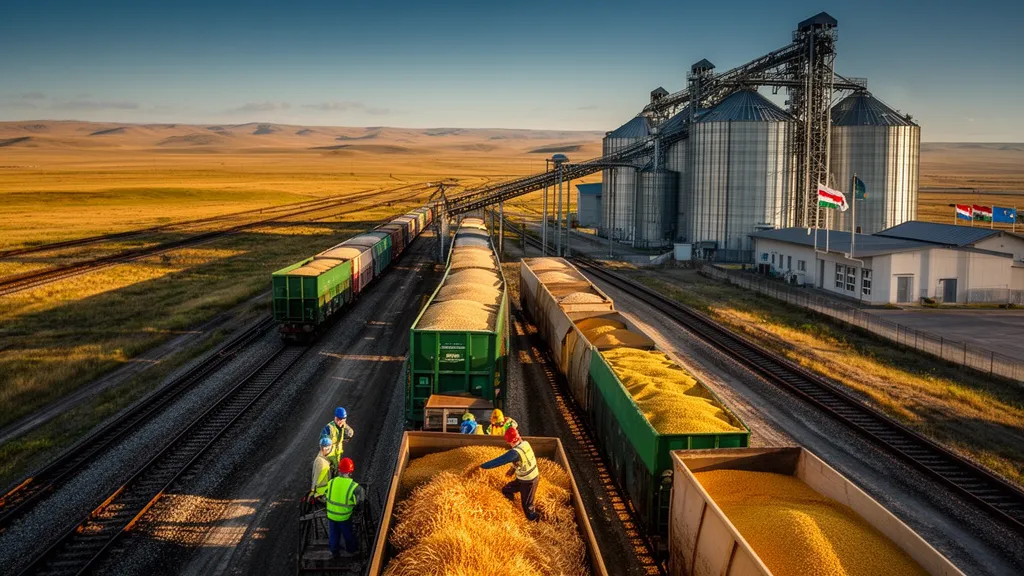
- Strategic Gateway: Kazakhstan is positioning Hungary as a key EU entry point for its agricultural exports, particularly processed and organic products.
- Mutual Market Access: Hungary gains improved access to Central Asia and China via Kazakh logistics, enhancing its regional trade reach.
- Agro-Industrial Investment: Hungarian companies plan significant investments in Kazakhstan’s feed, genetics, and irrigation sectors.
- Crop Collaboration: Joint trials of high-yield Hungarian crop varieties in Kazakhstan have shown positive results, supporting further cooperation.
- Logistics Impact: A potential overland rail freight corridor through Hungary could gradually divert some Kazakh volumes away from Black Sea maritime routes.
Kazakhstan–Hungary Logistics and Trade Expansion
Kazakhstan and Hungary are advancing discussions on an expanded logistics partnership that would establish Hungary as a strategic European gateway for Kazakh agricultural exports. The focus is on facilitating the movement of processed and organic Kazakh goods into the EU, leveraging Hungary’s geographic position and infrastructure.
In return, Kazakhstan would serve as a key logistical hub for Hungarian access to markets in Central Asia and China, creating a mutually beneficial corridor for bilateral trade and transit flows.
Agro-Industrial Cooperation and Investment
The partnership framework includes substantial Hungarian investment in Kazakhstan’s agro-industrial complex. Hungarian firms, including UBM Group, are already present in the country and plan to scale up with projects focused on feed and premix production, animal genetics, and modern irrigation solutions.
Both sides are also deepening technical cooperation in crop production. Kazakhstan has reported positive results from joint field tests of high-yielding Hungarian varieties of sorghum, wheat, triticale, barley, and alfalfa, laying the groundwork for wider adoption and further agronomic collaboration.
A delegation from the Hungarian Ministry of Agriculture is expected to visit Kazakhstan in early 2026 to assess additional investment opportunities and to refine joint projects across the agro-industrial value chain.
Market and Logistics Implications
This initiative marks a long-term strategic shift in regional trade architecture. By cultivating an overland rail freight route via Hungary, Kazakhstan is working to diversify its export pathways away from traditional Black Sea ports, enhancing resilience and reducing reliance on maritime corridors.
While the impact on current market pricing is limited in the near term, a reliable and efficient rail freight corridor into central Europe could eventually redirect a share of Kazakh export volume from sea to land. For Black Sea logistics operators, this development represents a neutral-to-bearish long-term signal, introducing new competition for transit flows and underscoring the need to monitor overland capacity and route competitiveness.
Source: Market Data
Leave a Reply