
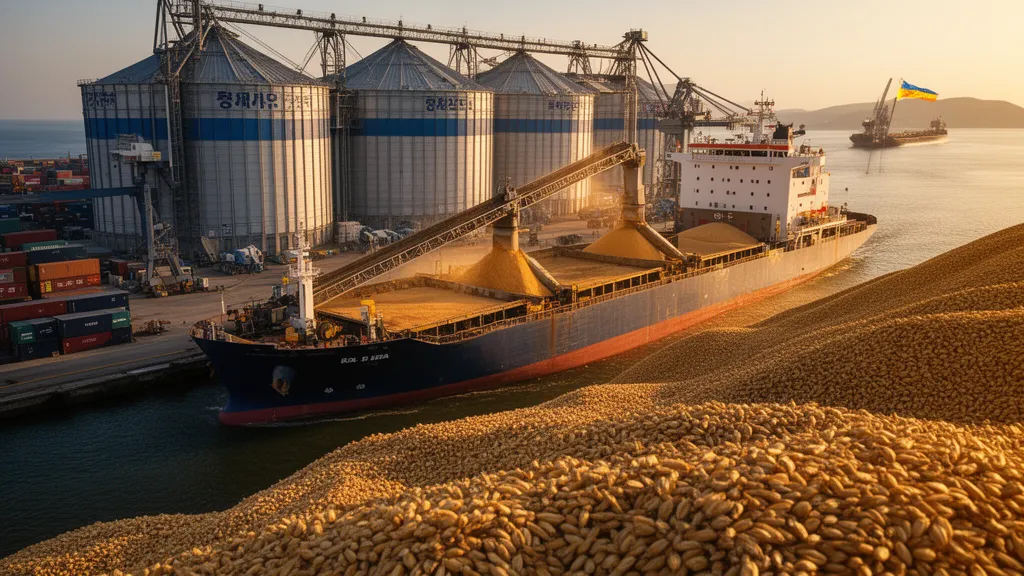
- South Korea’s NOFI secured around 65,000 mt of feed wheat for delivery by April 2026 in an international tender.
- The tender explicitly excluded Russian, Argentine, Pakistani, Danish, and Chinese origins, signaling targeted supply-chain de-risking.
- The $261.65/t C&F price (plus $1.30/t unloading) acts as a long‑dated benchmark but is expected to have minimal impact on current spot prices.
- Exclusion of Russian wheat could create incremental demand opportunities for alternative Black Sea suppliers such as Ukraine and Romania.
South Korea Secures Long-Dated Feed Wheat Supply
South Korean feed miller Nonghyup Feed Inc. (NOFI) has purchased a cargo of feed wheat in an international tender held on December 2, securing supply well in advance of the April 2026 delivery window. The deal underscores South Korea’s ongoing strategy to lock in key feed grains early, reducing exposure to future market and logistics volatility.
Operator Dreyfus was reported as the seller of the approximately 65,000 mt position. The tender allowed wheat of any origin with several notable exclusions, including Russia, Argentina, Pakistan, Denmark, and China, narrowing the pool of eligible exporters.
Tender Details and Pricing
| Buyer | Commodity | Volume (mt) | Price (C&F, $/t) | Port Unloading Fee ($/t) | Total Cost (C&F + Fee, $/t) | Arrival |
|---|---|---|---|---|---|---|
| NOFI (S. Korea) | Feed Wheat | ~65,000 | 261.65 | 1.30 | 262.95 | By April 15, 2026 |
The final price of $261.65/t C&F includes an additional $1.30/t earmarked for port unloading fees, bringing the effective cost basis to $262.95/t. Given the distant arrival date, the contract serves more as a forward benchmark than a driver of immediate spot market movement.
Market Impact and Black Sea Implications
The most significant feature of this tender for the Black Sea market is the explicit exclusion of Russian-origin wheat. While this is a single contract rather than a broad embargo, it highlights that certain major buyers are actively managing geopolitical and sanctions-related risks by diversifying away from Russian supply.
This creates incremental space for alternative Black Sea exporters such as Ukraine and Romania, as well as other non-excluded origins, to capture demand where Russian wheat is contractually ruled out. However, because the shipment is scheduled for April 2026, the tender reflects strategic positioning rather than current physical tightness and is likely to have a limited to neutral influence on short-term price levels.
Source: Market Data
Leave a Reply