
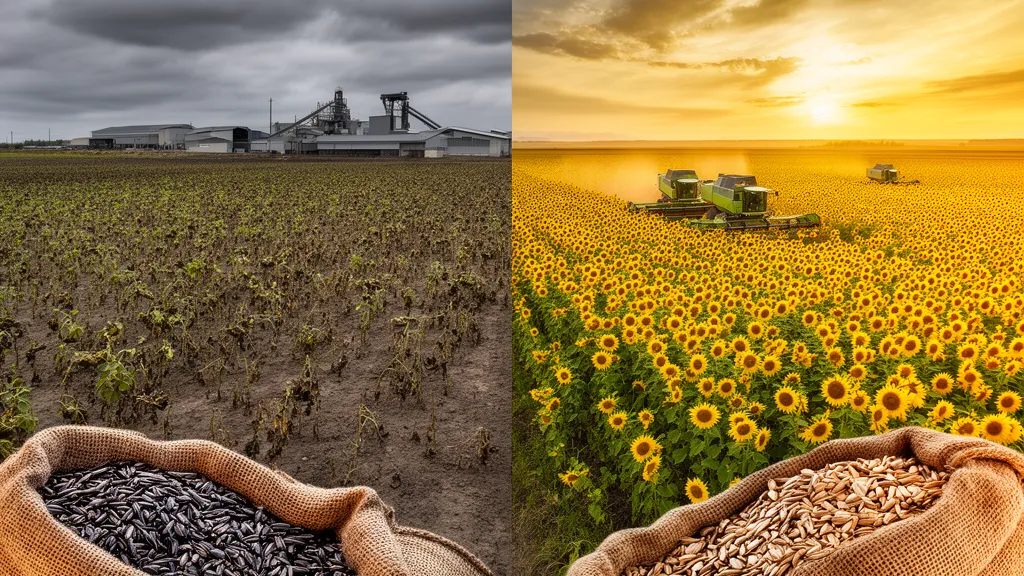
- Bullish (Ukraine farm-gate): A decade-low 2025 sunflower seed harvest of 11.4 MMT versus crushing capacity creates a 10.2 MMT supply deficit, supporting higher seed prices for growers.
- Bearish (Ukraine crushers): Raw material scarcity is set to leave nearly half of crushing plants underutilized, squeezing margins and forcing a shift toward soy and rapeseed.
- Bullish (Altai production): Russia’s Altai Krai is completing a record sunflower seed harvest of about 1.5 MMT, boosting local supply and potential export availability.
- Bearish (Altai prices): Depressed purchase prices, down sharply amid global oversupply and a strong ruble, have cut farm profitability in Altai to 58% from 128% in 2021.
Market Update: Ukraine Sunflower Seed Shortfall
Ukraine’s largest oilseed processor, Kernel, projects the country’s 2025 sunflower seed harvest at just 11.4 million tonnes (MMT), the lowest level in 10 years. This volume is far below the domestic crushing industry’s capacity, with the supply-to-capacity deficit estimated at 10.2 MMT. The imbalance signals an extended period of tight raw material availability for processors.
The shortage is already visible in industrial performance. Kernel reported an 18% year-on-year decline in its oilseed processing volumes in the July–September quarter, down to 559,000 tonnes. With fewer seeds available, competition among crushers is expected to intensify, driving up procurement costs and pressuring margins across the sector.
To offset the sunflower seed deficit, some Ukrainian processors may increasingly pivot to soybeans and rapeseed. A previously approved 10% export duty on these oilseeds provides policy support for this shift by making domestic crushing more attractive than raw seed exports. Even so, the overall utilization of sunflower-specific capacity is likely to remain well below potential.
Russia’s Altai Krai: Record Sunflower Harvest, Weak Prices
In sharp contrast to Ukraine’s shortfall, Russia’s Altai Krai region is completing a record sunflower seed harvest, estimated at around 1.5 MMT. Despite the strong output, local producers are struggling with falling purchase prices. The decline is attributed to a combination of global oilseed overproduction and the strength of the ruble, both of which are eroding export competitiveness and domestic price support.
Profitability in Altai has deteriorated significantly: margins this season are reported at about 58%, compared with a high of 128% in 2021. The sharp reversal underlines the impact of lower farm-gate prices and rising costs on producer economics. Some farmers are choosing to store their harvest in the hope of better prices in spring, while others with immediate cash flow needs may be forced to sell at current depressed levels.
Processor Buying Prices: Regional Spread in Russia
Current processor buying prices for sunflower seed in Russia show a wide spread between western regions and Altai, with further discounts at specific local buyers.
| Region / Buyer | Price per Ton (RUB) |
|---|---|
| Kursk Region (Start) | 36,800 |
| Altai Krai (General) | 22,700 – 27,200 |
| Novoaltaisk OEP | 14,545 |
Market Analysis and Price Direction
For Ukraine, the sunflower seed shortfall is bullish for farm-gate prices but bearish for crusher profitability and utilization. Higher seed costs will challenge processors unless they can pass them through to sunflower oil and meal buyers, which could prove difficult in a global environment already weighed down by reports of oversupply.
In Russia’s Altai Krai, the record harvest is locally bearish for prices. While the additional supply is significant, the region’s distance from major export ports may limit its immediate influence on broader Black Sea FOB indications. The divergence between tight Ukrainian supply and abundant Russian output is likely to create continued pricing tension, with the market closely monitoring Ukrainian crush rates versus the pace of Russian volumes reaching export channels.
Source: Market Data
Leave a Reply